
Dual Learning
☆☆☆☆☆
(0 reviews)
Lowest price (incl. delivery)
14 299,00 JPY
Typical price1 089,87 PLN
Lowest (90 days)71,50 PLN
Offers6
Last updated1 settimana fa
Price history (90 days)
Full history
2026-08-08
2026-08-15
| Aggiornato il | Prezzo |
|---|---|
| 2026-08-08 | 84,99 |
| 2026-08-15 | 71,50 |
| Venditore | Product price | Delivery | Totale | Disponibilità | Updated | |
|---|---|---|---|---|---|---|
| SP SpringerNatureLink Shop INT | 14 299,00 JPY | free | 14 299,00 JPY | Disponibile | 4 giorni fa | View offer |
| SP Springer Nature Author | 14 299,00 JPY | 15,00 JPY | 14 314,00 JPY | Disponibile | 1 settimana fa | View offer |
| SP SpringerNatureLink Shop INT | 99,99 USD | 29,00 USD | 128,99 USD | Disponibile | 4 giorni fa | View offer |
| SP SpringerNatureLink Shop INT | 109,99 USD | free | 109,99 USD | Disponibile | 4 giorni fa | View offer |
| SP SpringerNatureLink Shop INT | 109,99 USD | 29,00 USD | 138,99 USD | Disponibile | 4 giorni fa | View offer |
| SP SpringerNatureLink Shop INT | 118,00 EUR | 25,00 EUR | 143,00 EUR | Disponibile | 4 giorni fa | View offer |
I prezzi e la disponibilità possono variare. Ultimo aggiornamento: 08.08.2026 23:21.
0,0
☆☆☆☆☆
0 reviews
5★
0%
4★
0%
3★
0%
2★
0%
1★
0%
Product reviews
No reviews yet — be the first!
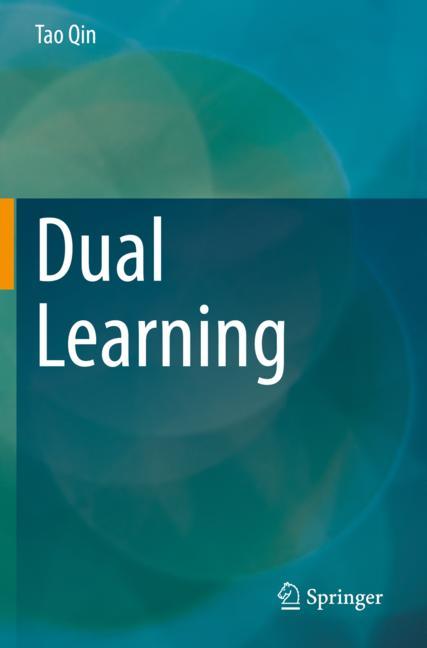
Many AI (and machine learning) tasks present in dual forms, e.g., English-to-Chinese translation vs. Chinese-to-English translation, speech recognition vs. speech synthesis,question answering vs. question generation, and image classification vs. image generation. Dual learning is a new learning framework that leverages the primal-dual structure of AI tasks to obtain effective feedback or regularization signals in order to enhance the learning/inference process. Since it was first introduced four years ago, the concept has attracted considerable attention in multiple fields, and been proven effective in numerous applications, such as machine translation, image-to-image translation, speech synthesis and recognition, (visual) question answering and generation, image captioning and generation, and code summarization and generation. Offering a systematic and comprehensive overview of dual learning, this book enables interested researchers (both established and newcomers) and practitioners to gain a better understanding of the state of the art in the field. It also provides suggestions for further reading and tools to help readers advance the area. The book is divided into five parts. The first part gives a brief introduction to machine learning and deep learning. The second part introduces the algorithms based on the dual reconstruction principle using machine translation, image translation, speech processing and other NLP/CV tasks as the demo applications. It covers algorithms, such as dual semi-supervised learning, dual unsupervised learning and multi-agent dual learning. In the context of image translation, it introduces algorithms including CycleGAN, DualGAN, DiscoGAN cdGAN and more recent techniques/applications. The third part presents various work based on the probability principle, including dual supervised learning and dual inference based on the joint-probability principle and dual semi-supervised learning based on the marginal-probability principle. The fourth part reviews various theoretical studies on dual learning and discusses its connections to other learning paradigms. The fifth part provides a summary and suggests future research directions.
Similar products
 50 Years of Philosophy and Medicine
from $107.30
50 Years of Philosophy and Medicine
from $107.30
 Understanding Cybersecurity Law and Digital Privacy
from $122.63
Understanding Cybersecurity Law and Digital Privacy
from $122.63
 Decisions in International Trade and Logistics
from $122.63
Decisions in International Trade and Logistics
from $122.63
 Advances in Economic Measurement
from $122.63
Advances in Economic Measurement
from $122.63
 Nanomaterials
from $137.96
Nanomaterials
from $137.96
 Sustainable Scaffolds-based Strategies in Tissue Engineering and Regenerative Medicine
from $162.87
Sustainable Scaffolds-based Strategies in Tissue Engineering and Regenerative Medicine
from $162.87
 Narratives in Educational Research
from $162.87
Narratives in Educational Research
from $162.87
 Environmental Biology of the Young Chinese Sturgeon
from $210.78
Environmental Biology of the Young Chinese Sturgeon
from $210.78