
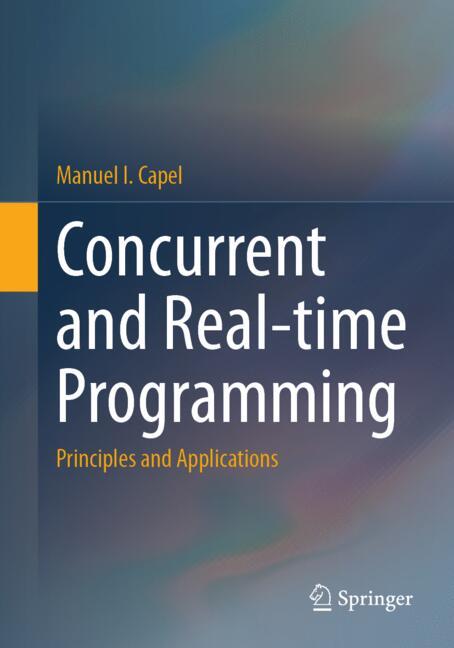
Concurrent and Real-time Programming
☆☆☆☆☆
(0 reviews)
Lowest price (incl. delivery)
41,99 USD
Typical price35,58 PLN
Lowest (90 days)31,49 PLN
Offers2
Last updated1 giorno fa
| Venditore | Product price | Delivery | Totale | Disponibilità | Updated | |
|---|---|---|---|---|---|---|
| SP SpringerNatureLink Shop INT | 41,99 USD | free | 41,99 USD | Disponibile | 1 giorno fa | View offer |
| SP Springer Nature Author | 41,99 USD | 29,00 USD | 70,99 USD | Disponibile | 1 giorno fa | View offer |
I prezzi e la disponibilità possono variare. Ultimo aggiornamento: 08.08.2026 11:15.
0,0
☆☆☆☆☆
0 reviews
5★
0%
4★
0%
3★
0%
2★
0%
1★
0%
Product reviews
No reviews yet — be the first!
This textbook provides a comprehensive exploration of the principles of concurrent programming, focusing on both theoretical foundations and practical implementation techniques. Its content ranges from basic concepts such as thread creation and process management to more advanced topics such as inter-process communication, synchronization mechanisms, and memory management. It includes discussions on monitors, MPI, RMI, rendezvous, and rate monotonic analysis, providing both foundational knowledge and practical solutions. The book is divided into four chapters, each building on fundamental aspects of concurrent and parallel programming. Chapter 1 introduces concurrent programming by explaining key concepts such as processes as independent execution units that perform tasks concurrently, concurrency models using techniques like mutual exclusion and synchronization primitives, and process creation through methods like fork/join and POSIX threads. Next, chapter 2 explores key process synchronization mechanisms in concurrent programming, focusing on both mutual exclusion problems and the use of monitors as a high-level solution for managing shared resources. Chapter 3 then focuses on message passing systems as a fundamental approach for communication and synchronization in distributed systems, where processes cannot share memory, and provides models like CSP and technologies like RMI to facilitate structured, reliable communication between processes. Eventually, chapter 4 dives into the scheduling mechanisms of real-time systems, focusing on how tasks are prioritized and scheduled to meet strict timing constraints with algorithms to address priority inversion while considering sporadic and aperiodic tasks. This book is designed to be used as a textbook for undergraduate and graduate courses in concurrent programming, operating systems, and distributed systems. Its well-structured layout, comprehensive case studies, numerous exercises, and illustrating real-world examples make it an ideal teaching resource.
Similar products
 Patient Safety Coaching
from $91.97
Patient Safety Coaching
from $91.97
 Ethnography and Diversity
from $69.30
Ethnography and Diversity
from $69.30
 Smart Villages
from $91.97
Smart Villages
from $91.97
 Nuclear Non-Proliferation in International Law - Volume VI
from $91.97
Nuclear Non-Proliferation in International Law - Volume VI
from $91.97
 The Price of Freedom
from $91.97
The Price of Freedom
from $91.97
 Eco-Social Policy in the OECD and the World Bank
from $91.97
Eco-Social Policy in the OECD and the World Bank
from $91.97
 Special Topics in Policing
from $122.58
Special Topics in Policing
from $122.58
 Music from the Heart
from $91.97
Music from the Heart
from $91.97