
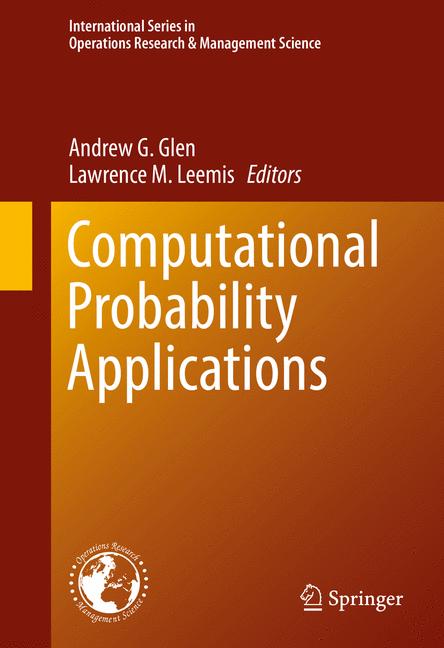
Computational Probability Applications
☆☆☆☆☆
(0 reviews)
Lowest price (incl. delivery)
14 299,00 JPY
Typical price1 042,14 PLN
Lowest (90 days)71,50 PLN
Offers6
Last updated6 giorni fa
Price history (90 days)
Full history
2026-08-08
2026-08-15
| Aggiornato il | Prezzo |
|---|---|
| 2026-08-08 | 84,99 |
| 2026-08-15 | 71,50 |
| Venditore | Product price | Delivery | Totale | Disponibilità | Updated | |
|---|---|---|---|---|---|---|
| SP SpringerNatureLink Shop INT | 14 299,00 JPY | free | 14 299,00 JPY | Disponibile | 7 ore fa | View offer |
| SP Springer Nature Author | 14 299,00 JPY | 19,00 JPY | 14 318,00 JPY | Disponibile | 6 giorni fa | View offer |
| SP SpringerNatureLink Shop INT | 99,99 USD | free | 99,99 USD | Disponibile | 12 ore fa | View offer |
| SP SpringerNatureLink Shop INT | 109,99 USD | 29,00 USD | 138,99 USD | Disponibile | 11 ore fa | View offer |
| SP SpringerNatureLink Shop INT | 109,99 USD | 25,00 USD | 134,99 USD | Disponibile | 11 ore fa | View offer |
| SP SpringerNatureLink Shop INT | 118,00 EUR | 19,00 EUR | 137,00 EUR | Disponibile | 10 ore fa | View offer |
I prezzi e la disponibilità possono variare. Ultimo aggiornamento: 08.08.2026 23:20.
0,0
☆☆☆☆☆
0 reviews
5★
0%
4★
0%
3★
0%
2★
0%
1★
0%
Product reviews
No reviews yet — be the first!
This focuses on the developing field of building probability models with the power of symbolic algebra systems. The book combines the uses of symbolic algebra with probabilistic/stochastic application and highlights the applications in a variety of contexts. The research explored in each chapter is unified by the use of A Probability Programming Language (APPL) to achieve the modeling objectives. APPL, as a research tool, enables a probabilist or statistician the ability to explore new ideas, methods, and models. Furthermore, as an open-source language, it sets the foundation for future algorithms to augment the original code. Computational Probability Applications is comprised of fifteen chapters, each presenting a specific application of computational probability using the APPL modeling and computer language. The chapter topics include using inverse gamma as a survival distribution, linear approximations of probability density functions, and also moment-ratio diagrams for univariate distributions. These works highlight interesting examples, often done by undergraduate students and graduate students that can serve as templates for future work. In addition, this book should appeal to researchers and practitioners in a range of fields including probability, statistics, engineering, finance, neuroscience, and economics.
Similar products
 50 Years of Philosophy and Medicine
from $107.30
50 Years of Philosophy and Medicine
from $107.30
 Understanding Cybersecurity Law and Digital Privacy
from $122.63
Understanding Cybersecurity Law and Digital Privacy
from $122.63
 Decisions in International Trade and Logistics
from $122.63
Decisions in International Trade and Logistics
from $122.63
 Advances in Economic Measurement
from $122.63
Advances in Economic Measurement
from $122.63
 Nanomaterials
from $137.96
Nanomaterials
from $137.96
 Sustainable Scaffolds-based Strategies in Tissue Engineering and Regenerative Medicine
from $162.87
Sustainable Scaffolds-based Strategies in Tissue Engineering and Regenerative Medicine
from $162.87
 Narratives in Educational Research
from $162.87
Narratives in Educational Research
from $162.87
 Environmental Biology of the Young Chinese Sturgeon
from $210.78
Environmental Biology of the Young Chinese Sturgeon
from $210.78