
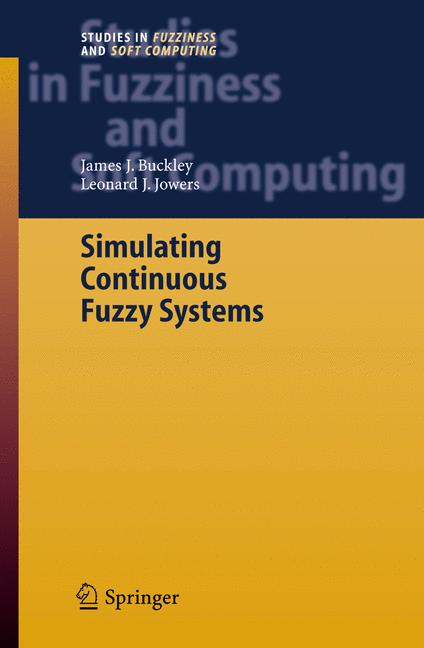
Simulating Continuous Fuzzy Systems
☆☆☆☆☆
(0 reviews)
Lowest price (incl. delivery)
21 449,00 JPY
Typical price2 982,80 PLN
Lowest (90 days)129,99 PLN
Offers8
Last updated6 hari yang lalu
Price history (90 days)
Full history
2026-08-08
2026-08-15
| Diperbarui Pada | Harga |
|---|---|
| 2026-08-08 | 129,99 |
| 2026-08-15 | 155,99 |
| Penjual | Product price | Delivery | Total | Ketersediaan | Updated | |
|---|---|---|---|---|---|---|
| SP SpringerNatureLink Shop INT | 21 449,00 JPY | free | 21 449,00 JPY | Tersedia | 12 jam yang lalu | View offer |
| SP Springer Nature Author | 21 449,00 JPY | 25,00 JPY | 21 474,00 JPY | Tersedia | 6 hari yang lalu | View offer |
| SP SpringerNatureLink Shop INT | 149,99 USD | free | 149,99 USD | Tersedia | 15 jam yang lalu | View offer |
| SP SpringerNatureLink Shop INT | 149,99 USD | 25,00 USD | 174,99 USD | Tersedia | 15 jam yang lalu | View offer |
| SP SpringerNatureLink Shop INT | 169,99 USD | 25,00 USD | 194,99 USD | Tersedia | 14 jam yang lalu | View offer |
| SP SpringerNatureLink Shop INT | 169,99 USD | free | 169,99 USD | Tersedia | 14 jam yang lalu | View offer |
| SP SpringerNatureLink Shop INT | 169,99 USD | 29,00 USD | 198,99 USD | Tersedia | 14 jam yang lalu | View offer |
| SP SpringerNatureLink Shop INT | 177,00 EUR | 25,00 EUR | 202,00 EUR | Tersedia | 14 jam yang lalu | View offer |
Harga dan ketersediaan dapat berubah. Terakhir Diperbarui: 08.08.2026 23:34.
0,0
☆☆☆☆☆
0 reviews
5★
0%
4★
0%
3★
0%
2★
0%
1★
0%
Product reviews
No reviews yet — be the first!
1. 1 Introduction This book is written in two major parts. The ?rst part includes the int- ductory chapters consisting of Chapters 1 through 6. In part two, Chapters 7-26, we present the applications. This book continues our research into simulating fuzzy systems. We started with investigating simulating discrete event fuzzy systems ([7],[13],[14]). These systems can usually be described as queuing networks. Items (transactions) arrive at various points in the s- tem and go into a queue waiting for service. The service stations, preceded by a queue, are connected forming a network of queues and service, until the transaction ?nally exits the system. Examples considered included - chine shops, emergency rooms, project networks, bus routes, etc. Analysis of all of these systems depends on parameters like arrival rates and service rates. These parameters are usually estimated from historical data. These estimators are generally point estimators. The point estimators are put into the model to compute system descriptors like mean time an item spends in the system, or the expected number of transactions leaving the system per unit time. We argued that these point estimators contain uncertainty not shown in the calculations. Our estimators of these parameters become fuzzy numbers, constructed by placing a set of con?dence intervals one on top of another. Using fuzzy number parameters in the model makes it into a fuzzy system. The system descriptors we want (time in system, number leaving per unit time) will be fuzzy numbers.
Similar products
 50 Years of Philosophy and Medicine
from $107.30
50 Years of Philosophy and Medicine
from $107.30
 Understanding Cybersecurity Law and Digital Privacy
from $122.63
Understanding Cybersecurity Law and Digital Privacy
from $122.63
 Decisions in International Trade and Logistics
from $122.63
Decisions in International Trade and Logistics
from $122.63
 Advances in Economic Measurement
from $122.63
Advances in Economic Measurement
from $122.63
 Nanomaterials
from $137.96
Nanomaterials
from $137.96
 Sustainable Scaffolds-based Strategies in Tissue Engineering and Regenerative Medicine
from $162.87
Sustainable Scaffolds-based Strategies in Tissue Engineering and Regenerative Medicine
from $162.87
 Narratives in Educational Research
from $162.87
Narratives in Educational Research
from $162.87
 Environmental Biology of the Young Chinese Sturgeon
from $210.78
Environmental Biology of the Young Chinese Sturgeon
from $210.78