
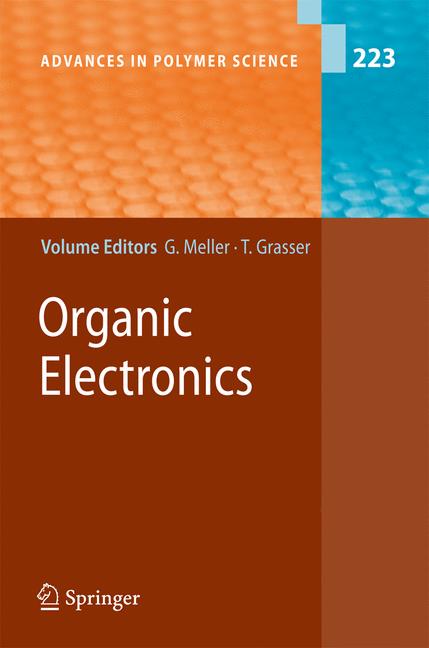
Organic Electronics
☆☆☆☆☆
(0 reviews)
Lowest price (incl. delivery)
328,99 USD
Typical price289,99 PLN
Lowest (90 days)249,99 PLN
Offers6
Last updated4 hari yang lalu
Price history (90 days)
Full history
2026-08-08
2026-08-15
| Diperbarui Pada | Harga |
|---|---|
| 2026-08-08 | 249,99 |
| 2026-08-15 | 329,99 |
| Penjual | Product price | Delivery | Total | Ketersediaan | Updated | |
|---|---|---|---|---|---|---|
| SP SpringerNatureLink Shop INT | 299,99 USD | 29,00 USD | 328,99 USD | Tersedia | 4 hari yang lalu | View offer |
| SP SpringerNatureLink Shop INT | 299,99 USD | 19,00 USD | 318,99 USD | Tersedia | 4 hari yang lalu | View offer |
| SP Springer Nature Author | 249,99 GBP | 29,00 GBP | 278,99 GBP | Tersedia | 1 minggu yang lalu | View offer |
| SP SpringerNatureLink Shop INT | 329,99 USD | 19,00 USD | 348,99 USD | Tersedia | 4 hari yang lalu | View offer |
| SP SpringerNatureLink Shop INT | 329,99 USD | 15,00 USD | 344,99 USD | Tersedia | 4 hari yang lalu | View offer |
| SP SpringerNatureLink Shop INT | 329,99 EUR | 15,00 EUR | 344,99 EUR | Tersedia | 4 hari yang lalu | View offer |
Harga dan ketersediaan dapat berubah. Terakhir Diperbarui: 15.08.2026 07:34.
0,0
☆☆☆☆☆
0 reviews
5★
0%
4★
0%
3★
0%
2★
0%
1★
0%
Product reviews
No reviews yet — be the first!
Dear Readers, Since the ground-breaking, Nobel-prize crowned work of Heeger, MacDiarmid, and Shirakawa on molecularly doped polymers and polymers with an alternating bonding structure at the end of the 1970s, the academic and industrial research on hydrocarbon-based semiconducting materials and devices has made encouraging progress. The strengths of semiconducting polymers are currently mainly unfolding in cheap and easily assembled thin ?lm transistors, light emitting diodes, and organic solar cells. The use of so-called “plastic chips” ranges from lightweight, portable devices over large-area applications to gadgets demanding a degree of mechanical ?exibility, which would overstress conventionaldevices based on inorganic,perfect crystals. The ?eld of organic electronics has evolved quite dynamically during the last few years; thus consumer electronics based on molecular semiconductors has gained suf?cient market attractiveness to be launched by the major manufacturers in the recent past. Nonetheless, the numerous challenges related to organic device physics and the physics of ordered and disordered molecular solids are still the subjects of a cont- uing lively debate. The future of organic microelectronics will unavoidably lead to new devi- physical insights and hence to novel compounds and device architectures of - hanced complexity. Thus, the early evolution of predictive models and precise, computationally effective simulation tools for computer-aided analysis and design of promising device prototypes will be of crucial importance.
Similar products
 Gamma Knife Neurosurgery in the Management of Intracranial Disorders
from $210.78
Gamma Knife Neurosurgery in the Management of Intracranial Disorders
from $210.78
 SDGs in Construction Economics and Organization
from $210.78
SDGs in Construction Economics and Organization
from $210.78
 Emerging Therapies in Neurorehabilitation III
from $210.78
Emerging Therapies in Neurorehabilitation III
from $210.78
 Ground Improvement Techniques
from $220.36
Ground Improvement Techniques
from $220.36
 Anomaly Detection in Video Surveillance
from $220.36
Anomaly Detection in Video Surveillance
from $220.36
 Mechanism and Machine Science
from $287.42
Mechanism and Machine Science
from $287.42
 Protein-Protein Interactions as New Drug Targets
from $287.42
Protein-Protein Interactions as New Drug Targets
from $287.42
 Proceedings of the 7th International Conference of Transportation Research Group of India (CTRG 2023
from $287.42
Proceedings of the 7th International Conference of Transportation Research Group of India (CTRG 2023
from $287.42