
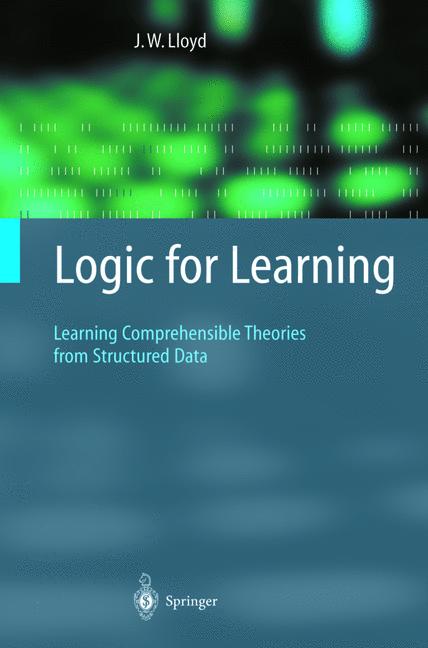
Logic for Learning
☆☆☆☆☆
(0 reviews)
Lowest price (incl. delivery)
42,79 USD
Typical price444,24 PLN
Lowest (90 days)35,99 PLN
Offers7
Last updated1 minggu yang lalu
Price history (90 days)
Full history
2026-08-08
2026-08-15
| Diperbarui Pada | Harga |
|---|---|
| 2026-08-08 | 39,99 |
| 2026-08-14 | 35,99 |
| 2026-08-15 | 51,99 |
| Penjual | Product price | Delivery | Total | Ketersediaan | Updated | |
|---|---|---|---|---|---|---|
| SP SpringerNatureLink Shop INT | 42,79 USD | free | 42,79 USD | Tersedia | 5 hari yang lalu | View offer |
| SP SpringerNatureLink Shop INT | 7 149,00 JPY | 19,00 JPY | 7 168,00 JPY | Tersedia | 5 hari yang lalu | View offer |
| SP Springer Nature Author | 7 149,00 JPY | 29,00 JPY | 7 178,00 JPY | Tersedia | 1 minggu yang lalu | View offer |
| SP SpringerNatureLink Shop INT | 49,99 USD | 19,00 USD | 68,99 USD | Tersedia | 5 hari yang lalu | View offer |
| SP SpringerNatureLink Shop INT | 54,99 USD | 25,00 USD | 79,99 USD | Tersedia | 5 hari yang lalu | View offer |
| SP SpringerNatureLink Shop INT | 54,99 USD | free | 54,99 USD | Tersedia | 5 hari yang lalu | View offer |
| SP SpringerNatureLink Shop INT | 59,00 EUR | 29,00 EUR | 88,00 EUR | Tersedia | 5 hari yang lalu | View offer |
Harga dan ketersediaan dapat berubah. Terakhir Diperbarui: 08.08.2026 23:09.
0,0
☆☆☆☆☆
0 reviews
5★
0%
4★
0%
3★
0%
2★
0%
1★
0%
Product reviews
No reviews yet — be the first!
This book is concerned with the rich and fruitful interplay between the fields of computational logic and machine learning. The intended audience is senior undergraduates, graduate students, and researchers in either of those fields. For those in computational logic, no previous knowledge of machine learning is assumed and, for those in machine learning, no previous knowledge of computational logic is assumed. The logic used throughout the book is a higher-order one. Higher-order logic is already heavily used in some parts of computer science, for example, theoretical computer science, functional programming, and hardware verifica tion, mainly because of its great expressive power. Similar motivations apply here as well: higher-order functions can have other functions as arguments and this capability can be exploited to provide abstractions for knowledge representation, methods for constructing predicates, and a foundation for logic-based computation. The book should be of interest to researchers in machine learning, espe cially those who study learning methods for structured data. Machine learn ing applications are becoming increasingly concerned with applications for which the individuals that are the subject of learning have complex struc ture. Typical applications include text learning for the World Wide Web and bioinformatics. Traditional methods for such applications usually involve the extraction of features to reduce the problem to one of attribute-value learning.
Similar products
 50 Years of Philosophy and Medicine
from $107.30
50 Years of Philosophy and Medicine
from $107.30
 Understanding Cybersecurity Law and Digital Privacy
from $122.63
Understanding Cybersecurity Law and Digital Privacy
from $122.63
 Decisions in International Trade and Logistics
from $122.63
Decisions in International Trade and Logistics
from $122.63
 Advances in Economic Measurement
from $122.63
Advances in Economic Measurement
from $122.63
 Nanomaterials
from $137.96
Nanomaterials
from $137.96
 Sustainable Scaffolds-based Strategies in Tissue Engineering and Regenerative Medicine
from $162.87
Sustainable Scaffolds-based Strategies in Tissue Engineering and Regenerative Medicine
from $162.87
 Narratives in Educational Research
from $162.87
Narratives in Educational Research
from $162.87
 Environmental Biology of the Young Chinese Sturgeon
from $210.78
Environmental Biology of the Young Chinese Sturgeon
from $210.78