
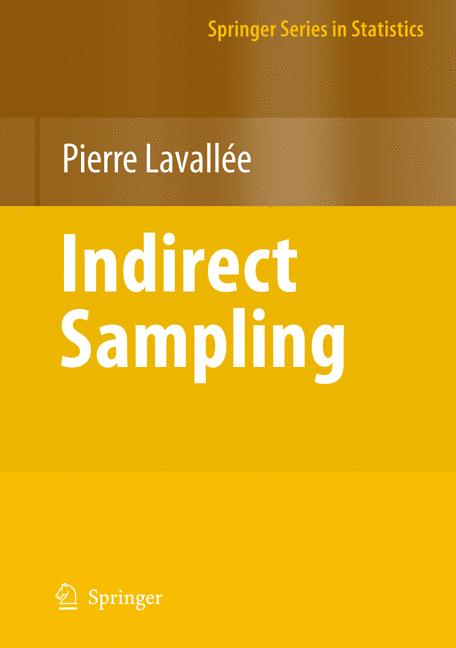
Indirect Sampling
☆☆☆☆☆
(0 reviews)
Lowest price (incl. delivery)
15 729,00 JPY
Typical price937,36 PLN
Lowest (90 days)99,99 PLN
Offers2
Last updated23 jam yang lalu
| Penjual | Product price | Delivery | Total | Ketersediaan | Updated | |
|---|---|---|---|---|---|---|
| SP Springer Nature Author | 15 729,00 JPY | free | 15 729,00 JPY | Tersedia | 23 jam yang lalu | View offer |
| SP SpringerNatureLink Shop INT | 114,39 EUR | 29,00 EUR | 143,39 EUR | Tersedia | 1 hari yang lalu | View offer |
Harga dan ketersediaan dapat berubah. Terakhir Diperbarui: 08.08.2026 23:23.
0,0
☆☆☆☆☆
0 reviews
5★
0%
4★
0%
3★
0%
2★
0%
1★
0%
Product reviews
No reviews yet — be the first!
Following the classical sampling theory, the survey statistician selects samples of people, businesses or others, in order to obtain the desired information. Drawing the samples is usually done by randomly selecting from a list representing the target population. In practice, this list is often not available. At best, the statistician only has access to a different list, indirectly related to the targeted population. The example of a survey of children where the statistician only has a list of adult persons is a typical case. In this case, the statistician first draws a sample of adults, and for each selected adult, the statistician then identifies his/her children. The survey is done from the latter. This is what is called indirect sampling. When indirect sampling is used jointly with the sampling of clusters of persons (families, for example), many complications arise for the survey statistician. One of the complications relates to the computation of the estimates from the survey. The production of estimates of simple totals or means can then become nightmares for the survey statistician. To solve this problem, the author proposes a simple solution, easy to implement, that is called the generalised weight share method. This book is the reference on indirect sampling and the generalised weight share method. It contains the different developments done by the author on these subjects. The theory surrounding them is presented, but also different possible applications that drive its interest. The reader will find in this book the answer to questions that come, inevitably, when working in a context of indirect sampling.
Similar products
 Patient Safety Coaching
from $91.97
Patient Safety Coaching
from $91.97
 Ethnography and Diversity
from $69.30
Ethnography and Diversity
from $69.30
 Smart Villages
from $91.97
Smart Villages
from $91.97
 Nuclear Non-Proliferation in International Law - Volume VI
from $91.97
Nuclear Non-Proliferation in International Law - Volume VI
from $91.97
 The Price of Freedom
from $91.97
The Price of Freedom
from $91.97
 Eco-Social Policy in the OECD and the World Bank
from $91.97
Eco-Social Policy in the OECD and the World Bank
from $91.97
 Special Topics in Policing
from $122.58
Special Topics in Policing
from $122.58
 Music from the Heart
from $91.97
Music from the Heart
from $91.97