
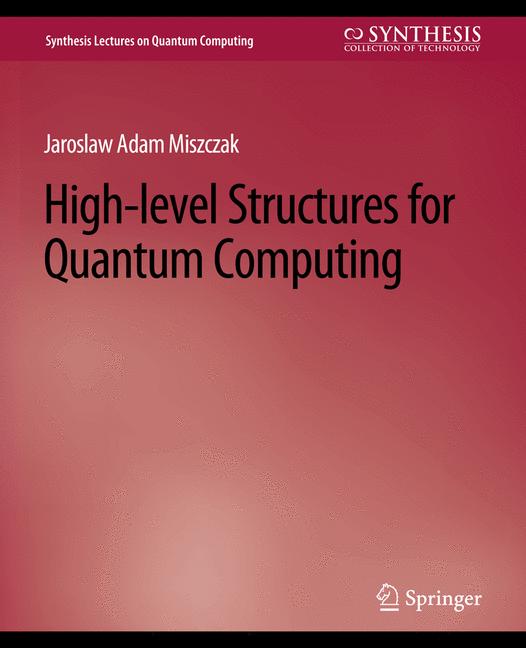
High Level Structures for Quantum Computing
☆☆☆☆☆
(0 reviews)
Lowest price (incl. delivery)
4 718,00 JPY
Typical price342,90 PLN
Lowest (90 days)14,37 PLN
Offers3
Last updated21 jam yang lalu
Price history (90 days)
Full history
2026-08-07
2026-08-08
| Diperbarui Pada | Harga |
|---|---|
| 2026-08-07 | 14,37 |
| 2026-08-08 | 34,31 |
| Penjual | Product price | Delivery | Total | Ketersediaan | Updated | |
|---|---|---|---|---|---|---|
| SP Springer Nature Author | 4 718,00 JPY | free | 4 718,00 JPY | Tersedia | 4 jam yang lalu | View offer |
| SP SpringerNatureLink Shop INT | 39,00 EUR | free | 39,00 EUR | Tersedia | 18 jam yang lalu | View offer |
| VI VitalSource | 199,24 ZAR | free | 199,24 ZAR | Tersedia | 21 jam yang lalu | View offer |
Harga dan ketersediaan dapat berubah. Terakhir Diperbarui: 08.08.2026 05:21.
EAN
9783031013881
Springer Nature
0,0
☆☆☆☆☆
0 reviews
5★
0%
4★
0%
3★
0%
2★
0%
1★
0%
Product reviews
No reviews yet — be the first!
This book is concerned with the models of quantum computation. Information processing based on the rules of quantum mechanics provides us with new opportunities for developing more efficient algorithms and protocols. However, to harness the power offered by quantum information processing it is essential to control the behavior of quantum mechanical objects in a precise manner. As this seems to be conceptually difficult at the level of quantum states and unitary gates, high-level quantum programming languages have been proposed for this purpose. The aim of this book is to provide an introduction to abstract models of computation used in quantum information theory. Starting from the abstract models of Turing machine and finite automata, we introduce the models of Boolean circuits and Random Access Machine and use them to present quantum programming techniques and quantum programming languages. Table of Contents: Introduction / Turing machines / Quantum Finite State Automata / Computational Circuits / Random Access Machines / Quantum Programming Environment / Quantum Programming Languages / Imperative quantum programming / Functional Quantum Programming / Outlook
Similar products
 Patient Safety Coaching
from $91.97
Patient Safety Coaching
from $91.97
 Ethnography and Diversity
from $69.30
Ethnography and Diversity
from $69.30
 Smart Villages
from $91.97
Smart Villages
from $91.97
 Nuclear Non-Proliferation in International Law - Volume VI
from $91.97
Nuclear Non-Proliferation in International Law - Volume VI
from $91.97
 The Price of Freedom
from $91.97
The Price of Freedom
from $91.97
 Eco-Social Policy in the OECD and the World Bank
from $91.97
Eco-Social Policy in the OECD and the World Bank
from $91.97
 Special Topics in Policing
from $122.58
Special Topics in Policing
from $122.58
 Music from the Heart
from $91.97
Music from the Heart
from $91.97