
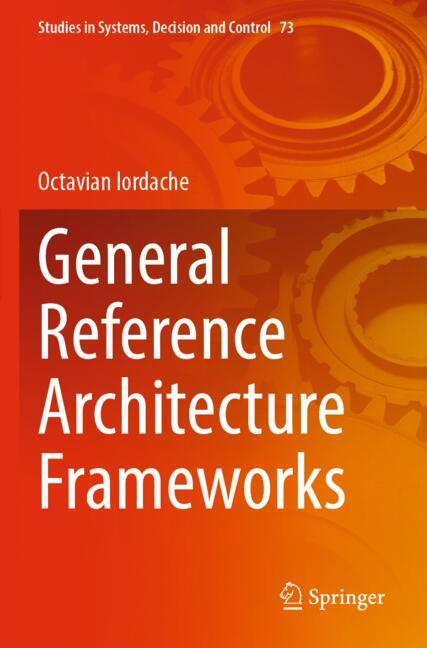
General Reference Architecture Frameworks
☆☆☆☆☆
(0 reviews)
Lowest price (incl. delivery)
208,99 USD
Typical price183,88 PLN
Lowest (90 days)159,99 PLN
Offers6
Last updated59 menit yang lalu
Price history (90 days)
Full history
2026-08-08
2026-08-15
| Diperbarui Pada | Harga |
|---|---|
| 2026-08-08 | 159,99 |
| 2026-08-15 | 159,99 |
| Penjual | Product price | Delivery | Total | Ketersediaan | Updated | |
|---|---|---|---|---|---|---|
| SP SpringerNatureLink Shop INT | 179,99 USD | 29,00 USD | 208,99 USD | Tersedia | 1 jam yang lalu | View offer |
| SP SpringerNatureLink Shop INT | 179,99 USD | free | 179,99 USD | Tersedia | 1 jam yang lalu | View offer |
| SP SpringerNatureLink Shop INT | 199,99 USD | free | 199,99 USD | Tersedia | 54 menit yang lalu | View offer |
| SP SpringerNatureLink Shop INT | 199,99 USD | 19,00 USD | 218,99 USD | Tersedia | 54 menit yang lalu | View offer |
| SP Springer Nature Author | 199,99 USD | 15,00 USD | 214,99 USD | Tersedia | 6 hari yang lalu | View offer |
| SP SpringerNatureLink Shop INT | 197,99 EUR | 19,00 EUR | 216,99 EUR | Tersedia | 59 menit yang lalu | View offer |
Harga dan ketersediaan dapat berubah. Terakhir Diperbarui: 15.08.2026 06:44.
0,0
☆☆☆☆☆
0 reviews
5★
0%
4★
0%
3★
0%
2★
0%
1★
0%
Product reviews
No reviews yet — be the first!
Studying high complexity projects implementation is the object of this book. Multiple interactions and emergences are the core of higher complexity and of associated models and projects. The starting point of our approach is the observed similarity or isomorphism of roadmaps toward higher complexity and of reference architectures for different domains of reality. The objective is to propose a General Polytopic Roadmaps (GPTR) and a General Reference Architecture Framework (GRAF) and use these for 8D Program implementation. The GPTR shows the stages: 0D, 1D, 2D, 4D, and 8D. The book is divided into 8 chapters. Chapter 1 introduces the GRAF as a 4D of 4D polytope. Chapter 2 emphasizes the role for the dialogue of processes in duality, of the logic of contradiction, of iteration and of included middle to face high complexity. Chapter 3 refers to operations and equipments of engineering interest as permutations, mixings and separations. Chapter 4 refers to modeling and simulation. Chapter 5 concerns creative design models. Dual process design, and processes integration are presented. Industry 4.0, future developments to Industry 8.0 and chemical engineering paradigms are evaluated in Chapter 6. Chapter 7 focuses on complex systems as production systems of systems architecture frameworks, decision models, operations processes, and cyber-physical social systems. Chapter 8 discusses implementation of high complexity projects for different levels of reality. The book is useful to engineers, researchers, entrepreneurs, and students in different branches of production, science, and engineering of high complexity.
Similar products
 Assessing, Explaining, and Rating AI Systems for Trust
from $30.65
Assessing, Explaining, and Rating AI Systems for Trust
from $30.65
 Digital Health Technologies and the Menopause
from $30.65
Digital Health Technologies and the Menopause
from $30.65
 Preparing College Faculty for Equitable Assessment
from $30.65
Preparing College Faculty for Equitable Assessment
from $30.65
 Managing Information Singularity
from $30.65
Managing Information Singularity
from $30.65
 Ingenious Principles of Nature
from $30.65
Ingenious Principles of Nature
from $30.65
 Reconceptualizing Exiting and Career Development in Sex Work
from $30.65
Reconceptualizing Exiting and Career Development in Sex Work
from $30.65
 Learning on the Margins
from $30.65
Learning on the Margins
from $30.65
 Jewish American Parents Navigating Autism Supports
from $30.65
Jewish American Parents Navigating Autism Supports
from $30.65