
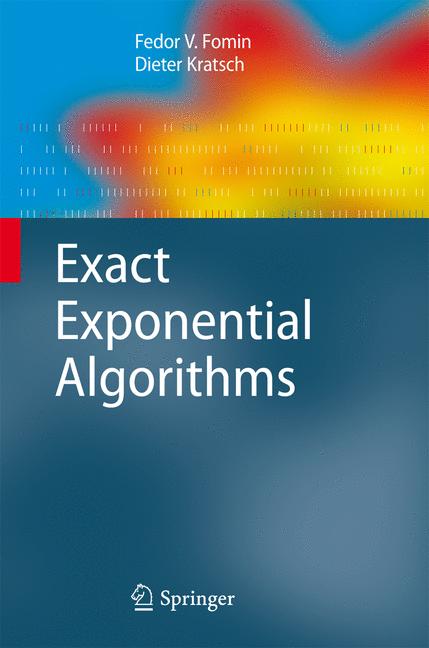
Exact Exponential Algorithms
☆☆☆☆☆
(0 reviews)
Lowest price (incl. delivery)
7 174,00 JPY
Typical price391,33 PLN
Lowest (90 days)35,99 PLN
Offers6
Last updated1 minggu yang lalu
Price history (90 days)
Full history
2026-08-08
2026-08-15
| Diperbarui Pada | Harga |
|---|---|
| 2026-08-08 | 39,99 |
| 2026-08-14 | 35,99 |
| 2026-08-15 | 51,99 |
| Penjual | Product price | Delivery | Total | Ketersediaan | Updated | |
|---|---|---|---|---|---|---|
| SP SpringerNatureLink Shop INT | 7 149,00 JPY | 25,00 JPY | 7 174,00 JPY | Tersedia | 3 hari yang lalu | View offer |
| SP Springer Nature Author | 7 149,00 JPY | 25,00 JPY | 7 174,00 JPY | Tersedia | 1 minggu yang lalu | View offer |
| SP SpringerNatureLink Shop INT | 74,99 USD | free | 74,99 USD | Tersedia | 3 hari yang lalu | View offer |
| SP SpringerNatureLink Shop INT | 64,99 GBP | 19,00 GBP | 83,99 GBP | Tersedia | 3 hari yang lalu | View offer |
| SP SpringerNatureLink Shop INT | 84,99 USD | 19,00 USD | 103,99 USD | Tersedia | 3 hari yang lalu | View offer |
| SP SpringerNatureLink Shop INT | 84,99 USD | free | 84,99 USD | Tersedia | 3 hari yang lalu | View offer |
Harga dan ketersediaan dapat berubah. Terakhir Diperbarui: 08.08.2026 23:09.
0,0
☆☆☆☆☆
0 reviews
5★
0%
4★
0%
3★
0%
2★
0%
1★
0%
Product reviews
No reviews yet — be the first!
For a long time computer scientists have distinguished between fast and slow algo rithms. Fast (or good) algorithms are the algorithms that run in polynomial time, which means that the number of steps required for the algorithm to solve a problem is bounded by some polynomial in the length of the input. All other algorithms are slow (or bad). The running time of slow algorithms is usually exponential. This book is about bad algorithms. There are several reasons why we are interested in exponential time algorithms. Most of us believe that there are many natural problems which cannot be solved by polynomial time algorithms. The most famous and oldest family of hard problems is the family of NP complete problems. Most likely there are no polynomial time al gorithms solving these hard problems and in the worst case scenario the exponential running time is unavoidable. Every combinatorial problem is solvable in ?nite time by enumerating all possi ble solutions, i. e. by brute force search. But is brute force search always unavoid able? De?nitely not. Already in the nineteen sixties and seventies it was known that some NP complete problems can be solved signi?cantly faster than by brute force search. Three classic examples are the following algorithms for the TRAVELLING SALESMAN problem, MAXIMUM INDEPENDENT SET, and COLORING.
Similar products
 50 Years of Philosophy and Medicine
from $107.30
50 Years of Philosophy and Medicine
from $107.30
 Understanding Cybersecurity Law and Digital Privacy
from $122.63
Understanding Cybersecurity Law and Digital Privacy
from $122.63
 Decisions in International Trade and Logistics
from $122.63
Decisions in International Trade and Logistics
from $122.63
 Advances in Economic Measurement
from $122.63
Advances in Economic Measurement
from $122.63
 Nanomaterials
from $137.96
Nanomaterials
from $137.96
 Sustainable Scaffolds-based Strategies in Tissue Engineering and Regenerative Medicine
from $162.87
Sustainable Scaffolds-based Strategies in Tissue Engineering and Regenerative Medicine
from $162.87
 Narratives in Educational Research
from $162.87
Narratives in Educational Research
from $162.87
 Environmental Biology of the Young Chinese Sturgeon
from $210.78
Environmental Biology of the Young Chinese Sturgeon
from $210.78