
Engineering Thermofluids
☆☆☆☆☆
(0 reviews)
Lowest price (incl. delivery)
234,99 USD
Typical price242,03 PLN
Lowest (90 days)228,79 PLN
Offers6
Last updated2 दिन पहले
Price history (90 days)
Full history
2026-08-08
2026-08-15
| अपडेट किया गया | कीमत |
|---|---|
| 2026-08-08 | 249,99 |
| 2026-08-15 | 228,79 |
| विक्रेता | Product price | Delivery | कुल | उपलब्धता | Updated | |
|---|---|---|---|---|---|---|
| SP SpringerNatureLink Shop INT | 219,99 USD | 15,00 USD | 234,99 USD | उपलब्ध | 2 दिन पहले | View offer |
| SP SpringerNatureLink Shop INT | 219,99 USD | free | 219,99 USD | उपलब्ध | 2 दिन पहले | View offer |
| SP SpringerNatureLink Shop INT | 249,99 USD | 29,00 USD | 278,99 USD | उपलब्ध | 2 दिन पहले | View offer |
| SP SpringerNatureLink Shop INT | 249,99 USD | 25,00 USD | 274,99 USD | उपलब्ध | 2 दिन पहले | View offer |
| SP Springer Nature Author | 249,99 USD | 19,00 USD | 268,99 USD | उपलब्ध | 1 सप्ताह पहले | View offer |
| SP SpringerNatureLink Shop INT | 241,99 EUR | 29,00 EUR | 270,99 EUR | उपलब्ध | 2 दिन पहले | View offer |
कीमतें और उपलब्धता बदल सकती हैं। अंतिम अपडेट: 15.08.2026 07:18.
0,0
☆☆☆☆☆
0 reviews
5★
0%
4★
0%
3★
0%
2★
0%
1★
0%
Product reviews
No reviews yet — be the first!
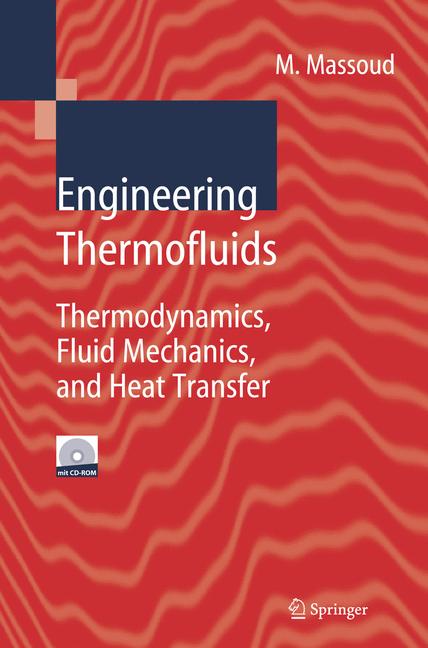
Thermofluids, while a relatively modern term, is applied to the well-established field of thermal sciences, which is comprised of various intertwined disciplines. Thus mass, momentum, and heat transfer constitute the fundamentals of th- mofluids. This book discusses thermofluids in the context of thermodynamics, single- and two-phase flow, as well as heat transfer associated with single- and two-phase flows. Traditionally, the field of thermal sciences is taught in univer- ties by requiring students to study engineering thermodynamics, fluid mechanics, and heat transfer, in that order. In graduate school, these topics are discussed at more advanced levels. In recent years, however, there have been attempts to in- grate these topics through a unified approach. This approach makes sense as thermal design of widely varied systems ranging from hair dryers to semicond- tor chips to jet engines to nuclear power plants is based on the conservation eq- tions of mass, momentum, angular momentum, energy, and the second law of thermodynamics. While integrating these topics has recently gained popularity, it is hardly a new approach. For example, Bird, Stewart, and Lightfoot in Transport Phenomena, Rohsenow and Choi in Heat, Mass, and Momentum Transfer, El- Wakil, in Nuclear Heat Transport, and Todreas and Kazimi in Nuclear Systems have pursued a similar approach. These books, however, have been designed for advanced graduate level courses. More recently, undergraduate books using an - tegral approach are appearing.
Similar products
 50 Years of Philosophy and Medicine
from $107.30
50 Years of Philosophy and Medicine
from $107.30
 Understanding Cybersecurity Law and Digital Privacy
from $122.63
Understanding Cybersecurity Law and Digital Privacy
from $122.63
 Decisions in International Trade and Logistics
from $122.63
Decisions in International Trade and Logistics
from $122.63
 Advances in Economic Measurement
from $122.63
Advances in Economic Measurement
from $122.63
 Nanomaterials
from $137.96
Nanomaterials
from $137.96
 Sustainable Scaffolds-based Strategies in Tissue Engineering and Regenerative Medicine
from $162.87
Sustainable Scaffolds-based Strategies in Tissue Engineering and Regenerative Medicine
from $162.87
 Narratives in Educational Research
from $162.87
Narratives in Educational Research
from $162.87
 Environmental Biology of the Young Chinese Sturgeon
from $210.78
Environmental Biology of the Young Chinese Sturgeon
from $210.78