
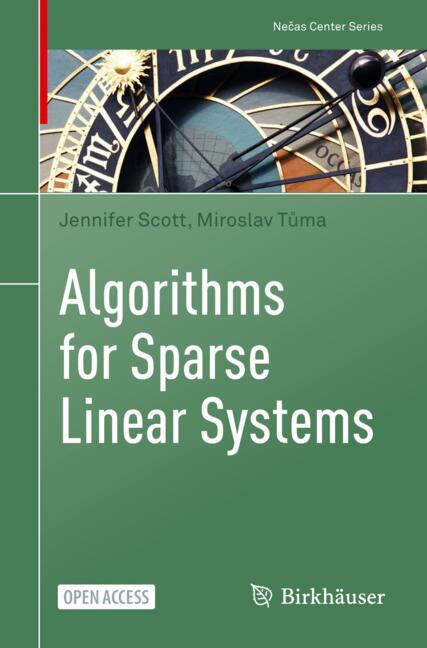
Algorithms for Sparse Linear Systems
☆☆☆☆☆
(0 reviews)
Lowest price (incl. delivery)
5 734,00 JPY
Typical price2 053,16 PLN
Lowest (90 days)34,99 PLN
Offers6
Last updated1 सप्ताह पहले
Price history (90 days)
Full history
2026-08-08
2026-08-15
| अपडेट किया गया | कीमत |
|---|---|
| 2026-08-08 | 39,99 |
| 2026-08-14 | 34,99 |
| 2026-08-15 | 5 719,00 |
| विक्रेता | Product price | Delivery | कुल | उपलब्धता | Updated | |
|---|---|---|---|---|---|---|
| SP SpringerNatureLink Shop INT | 5 719,00 JPY | 15,00 JPY | 5 734,00 JPY | उपलब्ध | 2 दिन पहले | View offer |
| SP Springer Nature Author | 5 719,00 JPY | 29,00 JPY | 5 748,00 JPY | उपलब्ध | 1 सप्ताह पहले | View offer |
| SP SpringerNatureLink Shop INT | 39,99 USD | 29,00 USD | 68,99 USD | उपलब्ध | 3 दिन पहले | View offer |
| SP SpringerNatureLink Shop INT | 43,99 EUR | 19,00 EUR | 62,99 EUR | उपलब्ध | 3 दिन पहले | View offer |
| SP SpringerNatureLink Shop INT | 49,99 USD | 15,00 USD | 64,99 USD | उपलब्ध | 3 दिन पहले | View offer |
| SP SpringerNatureLink Shop INT | 49,99 USD | free | 49,99 USD | उपलब्ध | 3 दिन पहले | View offer |
कीमतें और उपलब्धता बदल सकती हैं। अंतिम अपडेट: 08.08.2026 23:08.
0,0
☆☆☆☆☆
0 reviews
5★
0%
4★
0%
3★
0%
2★
0%
1★
0%
Product reviews
No reviews yet — be the first!
Large sparse linear systems of equations are ubiquitous in science, engineering and beyond. This open access monograph focuses on factorization algorithms for solving such systems. It presents classical techniques for complete factorizations that are used in sparse direct methods and discusses the computation of approximate direct and inverse factorizations that are key to constructing general-purpose algebraic preconditioners for iterative solvers. A unified framework is used that emphasizes the underlying sparsity structures and highlights the importance of understanding sparse direct methods when developing algebraic preconditioners. Theoretical results are complemented by sparse matrix algorithm outlines. This monograph is aimed at students of applied mathematics and scientific computing, as well as computational scientists and software developers who are interested in understanding the theory and algorithms needed to tackle sparse systems. It is assumed that the reader has completed a basic course in linear algebra and numerical mathematics.
Similar products
 50 Years of Philosophy and Medicine
from $107.30
50 Years of Philosophy and Medicine
from $107.30
 Understanding Cybersecurity Law and Digital Privacy
from $122.63
Understanding Cybersecurity Law and Digital Privacy
from $122.63
 Decisions in International Trade and Logistics
from $122.63
Decisions in International Trade and Logistics
from $122.63
 Advances in Economic Measurement
from $122.63
Advances in Economic Measurement
from $122.63
 Nanomaterials
from $137.96
Nanomaterials
from $137.96
 Sustainable Scaffolds-based Strategies in Tissue Engineering and Regenerative Medicine
from $162.87
Sustainable Scaffolds-based Strategies in Tissue Engineering and Regenerative Medicine
from $162.87
 Narratives in Educational Research
from $162.87
Narratives in Educational Research
from $162.87
 Environmental Biology of the Young Chinese Sturgeon
from $210.78
Environmental Biology of the Young Chinese Sturgeon
from $210.78