
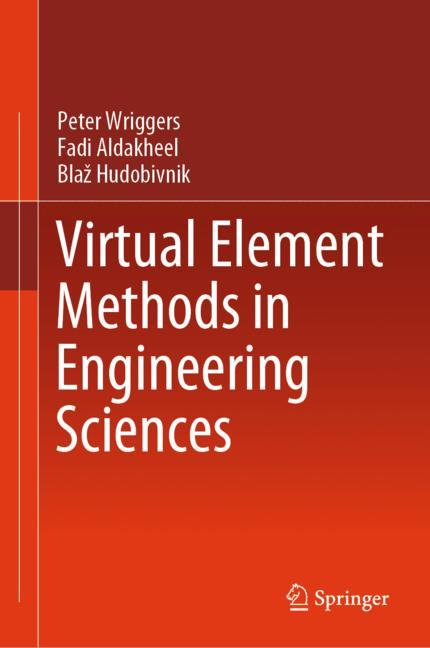
Virtual Element Methods in Engineering Sciences
☆☆☆☆☆
(0 reviews)
Lowest price (incl. delivery)
241,50 EUR
Typical price209,68 PLN
Lowest (90 days)54,00 PLN
Offers2
Last updatedil y a 1 jour
| Vendeur | Product price | Delivery | Total | Disponibilité | Updated | |
|---|---|---|---|---|---|---|
| SP Springer Nature Author | 212,50 EUR | 29,00 EUR | 241,50 EUR | Disponible | il y a 21 heures | View offer |
| VI VitalSource | 1 132,80 ZAR | 25,00 ZAR | 1 157,80 ZAR | Disponible | il y a 1 jour | View offer |
Les prix et la disponibilité peuvent changer. Dernière mise à jour: 08.08.2026 06:36.
EAN
9783031392542
Springer Nature
0,0
☆☆☆☆☆
0 reviews
5★
0%
4★
0%
3★
0%
2★
0%
1★
0%
Product reviews
No reviews yet — be the first!
This book provides a comprehensive treatment of the virtual element method (VEM) for engineering applications, focusing on its application in solid mechanics. Starting with a continuum mechanics background, the book establishes the necessary foundation for understanding the subsequent chapters. It then delves into the VEM's Ansatz functions and projection techniques, both for solids and the Poisson equation, which are fundamental to the method. The book explores the virtual element formulation for elasticity problems, offering insights into its advantages and capabilities. Moving beyond elasticity, the VEM is extended to problems in dynamics, enabling the analysis of dynamic systems with accuracy and efficiency. The book also covers the virtual element formulation for finite plasticity, providing a framework for simulating the behavior of materials undergoing plastic deformation. Furthermore, the VEM is applied to thermo-mechanical problems, where it allows for the investigation ofcoupled thermal and mechanical effects. The book dedicates a significant portion to the virtual elements for fracture processes, presenting techniques to model and analyze fractures in engineering structures. It also addresses contact problems, showcasing the VEM's effectiveness in dealing with contact phenomena. The virtual element method's versatility is further demonstrated through its application in homogenization, offering a means to understand the effective behavior of composite materials and heterogeneous structures. Finally, the book concludes with the virtual elements for beams and plates, exploring their application in these specific structural elements. Throughout the book, the authors emphasize the advantages of the virtual element method over traditional finite element discretization schemes, highlighting its accuracy, flexibility, and computational efficiency in various engineering contexts.
Similar products
 Gamma Knife Neurosurgery in the Management of Intracranial Disorders
from $210.78
Gamma Knife Neurosurgery in the Management of Intracranial Disorders
from $210.78
 SDGs in Construction Economics and Organization
from $210.78
SDGs in Construction Economics and Organization
from $210.78
 Emerging Therapies in Neurorehabilitation III
from $210.78
Emerging Therapies in Neurorehabilitation III
from $210.78
 Ground Improvement Techniques
from $220.36
Ground Improvement Techniques
from $220.36
 Anomaly Detection in Video Surveillance
from $220.36
Anomaly Detection in Video Surveillance
from $220.36
 Mechanism and Machine Science
from $287.42
Mechanism and Machine Science
from $287.42
 Protein-Protein Interactions as New Drug Targets
from $287.42
Protein-Protein Interactions as New Drug Targets
from $287.42
 Proceedings of the 7th International Conference of Transportation Research Group of India (CTRG 2023
from $287.42
Proceedings of the 7th International Conference of Transportation Research Group of India (CTRG 2023
from $287.42