
PID Control
☆☆☆☆☆
(0 reviews)
Lowest price (incl. delivery)
21 464,00 JPY
Typical price2 706,57 PLN
Lowest (90 days)117,69 PLN
Offers6
Last updatedil y a 6 jours
Price history (90 days)
Full history
2026-08-08
2026-08-15
| Mis à jour le | Prix |
|---|---|
| 2026-08-08 | 117,69 |
| 2026-08-15 | 117,69 |
| Vendeur | Product price | Delivery | Total | Disponibilité | Updated | |
|---|---|---|---|---|---|---|
| SP SpringerNatureLink Shop INT | 21 449,00 JPY | 15,00 JPY | 21 464,00 JPY | Disponible | il y a 3 heures | View offer |
| SP Springer Nature Author | 21 449,00 JPY | free | 21 449,00 JPY | Disponible | il y a 6 jours | View offer |
| SP SpringerNatureLink Shop INT | 149,99 USD | free | 149,99 USD | Disponible | il y a 6 heures | View offer |
| SP SpringerNatureLink Shop INT | 169,99 USD | 15,00 USD | 184,99 USD | Disponible | il y a 5 heures | View offer |
| SP SpringerNatureLink Shop INT | 169,99 USD | 19,00 USD | 188,99 USD | Disponible | il y a 5 heures | View offer |
| SP SpringerNatureLink Shop INT | 177,00 EUR | 29,00 EUR | 206,00 EUR | Disponible | il y a 5 heures | View offer |
Les prix et la disponibilité peuvent changer. Dernière mise à jour: 08.08.2026 23:28.
0,0
☆☆☆☆☆
0 reviews
5★
0%
4★
0%
3★
0%
2★
0%
1★
0%
Product reviews
No reviews yet — be the first!
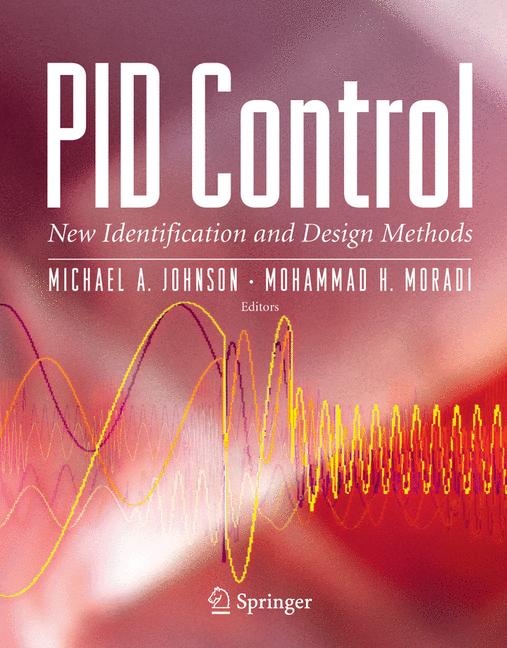
The effectiveness of proportional-integral-derivative (PID) controllers for a large class of process systems has ensured their continued and widespread use in industry. Similarly there has been a continued interest from academia in devising new ways of approaching the PID tuning problem. To the industrial engineer and many control academics this work has previously appeared fragmented; but a key determinant of this literature is the type of process model information used in the PID tuning methods. PID Control presents a set of coordinated contributions illustrating methods, old and new, that cover the range of process model assumptions systematically. After a review of PID technology, these contributions begin with model-free methods, progress through non-parametric model methods (relay experiment and phase-locked-loop procedures), visit fuzzy-logic- and genetic-algorithm-based methods; introduce a novel subspace identification method before closing with an interesting set of parametric model techniques including a chapter on predictive PID controllers. Highlights of PID Control include: an introduction to PID control technology features and typical industrial implementations; chapter contributions ordered by the increasing quality of the model information used; novel PID control concepts for multivariable processes. PID Control will be useful to industry-based engineers wanting a better understanding of what is involved in the steps to a new generation of PID controller techniques. Academics wishing to have a broader perspective of PID control research and development will find useful pedagogical material and research ideas in this text.
Similar products
 50 Years of Philosophy and Medicine
from $107.30
50 Years of Philosophy and Medicine
from $107.30
 Understanding Cybersecurity Law and Digital Privacy
from $122.63
Understanding Cybersecurity Law and Digital Privacy
from $122.63
 Decisions in International Trade and Logistics
from $122.63
Decisions in International Trade and Logistics
from $122.63
 Advances in Economic Measurement
from $122.63
Advances in Economic Measurement
from $122.63
 Nanomaterials
from $137.96
Nanomaterials
from $137.96
 Sustainable Scaffolds-based Strategies in Tissue Engineering and Regenerative Medicine
from $162.87
Sustainable Scaffolds-based Strategies in Tissue Engineering and Regenerative Medicine
from $162.87
 Narratives in Educational Research
from $162.87
Narratives in Educational Research
from $162.87
 Environmental Biology of the Young Chinese Sturgeon
from $210.78
Environmental Biology of the Young Chinese Sturgeon
from $210.78