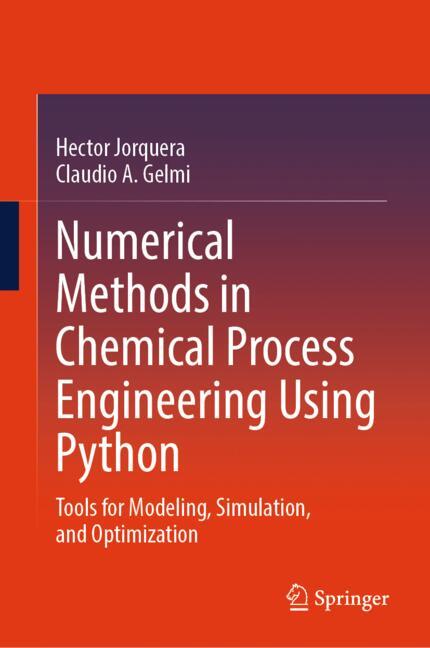
Numerical Methods in Chemical Process Engineering Using Python
☆☆☆☆☆
(0 reviews)
Lowest price (incl. delivery)
12 154,00 JPY
Typical price93,65 PLN
Lowest (90 days)89,66 PLN
Offers2
Last updatedil y a 1 mois
| Vendeur | Product price | Delivery | Total | Disponibilité | Updated | |
|---|---|---|---|---|---|---|
| SpringerNatureLink Shop INT | Product price 12 154,00 JPY | Delivery free | Total 12 154,00 JPY | Disponibilité Disponible | Updated il y a 1 mois | View offer |
| SpringerNatureLink Shop INT | Product price 100,50 EUR ▲ 7,5% | Delivery 19,00 EUR | Total 119,50 EUR | Disponibilité Disponible | Updated il y a 1 mois | View offer |
Les prix et la disponibilité peuvent changer. Dernière mise à jour: 15.08.2026 07:59.
EAN
9783032229571
Springer Nature
0,0
☆☆☆☆☆
0 reviews
5★
0%
4★
0%
3★
0%
2★
0%
1★
0%
Product reviews
No reviews yet — be the first!
This book provides an overview of the most widely used numerical methods in chemical process engineering organized by increasing levels of complexity. The book begins with numerical linear algebra, which is essential for solving large systems of equations, and continues with nonlinear equations, a cornerstone for modeling equilibrium and reaction kinetics. Ordinary differential equations are then addressed, covering both initial value and boundary value problems, with an emphasis on their role in describing dynamic behavior and transport phenomena. The section concludes with partial differential equations, which are fundamental for capturing spatial and temporal variations in heat, mass, and momentum transfer. The second part of the book presents a curated set of solved problems, each supported by Python code and figures. Covering topics such as parameter estimation, confidence intervals, and bioreactor optimization, the problems emphasize both steady-state and dynamic systems. Each example covers the deriving governing equations, related code, and interpreting results, providing a consistent learning path, while additional discussions encourage students to explore related concepts beyond the presented problem.
Similar products
 50 Years of Philosophy and Medicine
from $107.30
50 Years of Philosophy and Medicine
from $107.30
 Understanding Cybersecurity Law and Digital Privacy
from $122.63
Understanding Cybersecurity Law and Digital Privacy
from $122.63
 Decisions in International Trade and Logistics
from $122.63
Decisions in International Trade and Logistics
from $122.63
 Advances in Economic Measurement
from $122.63
Advances in Economic Measurement
from $122.63
 Nanomaterials
from $137.96
Nanomaterials
from $137.96
 Sustainable Scaffolds-based Strategies in Tissue Engineering and Regenerative Medicine
from $162.87
Sustainable Scaffolds-based Strategies in Tissue Engineering and Regenerative Medicine
from $162.87
 Narratives in Educational Research
from $162.87
Narratives in Educational Research
from $162.87
 Environmental Biology of the Young Chinese Sturgeon
from $210.78
Environmental Biology of the Young Chinese Sturgeon
from $210.78