
Future Design
☆☆☆☆☆
(0 reviews)
Lowest price (incl. delivery)
18 589,00 JPY
Typical price1 646,97 PLN
Lowest (90 days)87,50 PLN
Offers6
Last updatedil y a 1 semaine
Price history (90 days)
Full history
2026-08-08
2026-08-15
| Mis à jour le | Prix |
|---|---|
| 2026-08-08 | 87,50 |
| 2026-08-15 | 87,50 |
| Vendeur | Product price | Delivery | Total | Disponibilité | Updated | |
|---|---|---|---|---|---|---|
| SP SpringerNatureLink Shop INT | 18 589,00 JPY | free | 18 589,00 JPY | Disponible | il y a 4 jours | View offer |
| SP Springer Nature Author | 18 589,00 JPY | 29,00 JPY | 18 618,00 JPY | Disponible | il y a 1 semaine | View offer |
| SP SpringerNatureLink Shop INT | 129,99 USD | free | 129,99 USD | Disponible | il y a 4 jours | View offer |
| SP SpringerNatureLink Shop INT | 139,99 USD | free | 139,99 USD | Disponible | il y a 4 jours | View offer |
| SP SpringerNatureLink Shop INT | 139,99 USD | free | 139,99 USD | Disponible | il y a 4 jours | View offer |
| SP SpringerNatureLink Shop INT | 153,50 EUR | 15,00 EUR | 168,50 EUR | Disponible | il y a 4 jours | View offer |
Les prix et la disponibilité peuvent changer. Dernière mise à jour: 08.08.2026 22:23.
0,0
☆☆☆☆☆
0 reviews
5★
0%
4★
0%
3★
0%
2★
0%
1★
0%
Product reviews
No reviews yet — be the first!
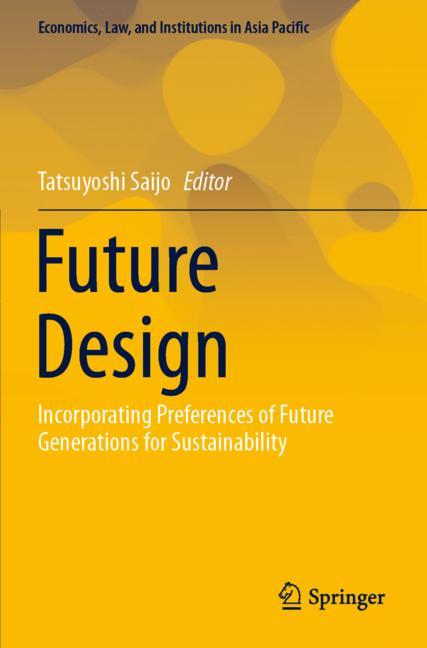
This book discusses imaginary future generations and how current decision-making will influence those future generations. Markets and democracies focus on the present and therefore tend to make us forget that we are living in the present, with ancestors preceding and descendants succeeding us. Markets are excellent devices to equate supply and demand in the short term, but not for allocating resources between current and future generations, since future generations do not exist yet. Democracy is also not “applicable” for future generations, since citizens vote for candidates who will serve members of their, i.e., the current, generation. In order to overcome these shortcomings, the authors discusses imaginary future generations and future ministries in the context of current decision-making in fields such as the environment, urban management, forestry, water management, and finance. The idea of imaginary future generations comes from the Native American Iroquois, who had strong norms that compelled them to incorporate the interests of people seven generations ahead when making decisions.
Similar products
 50 Years of Philosophy and Medicine
from $107.30
50 Years of Philosophy and Medicine
from $107.30
 Understanding Cybersecurity Law and Digital Privacy
from $122.63
Understanding Cybersecurity Law and Digital Privacy
from $122.63
 Decisions in International Trade and Logistics
from $122.63
Decisions in International Trade and Logistics
from $122.63
 Advances in Economic Measurement
from $122.63
Advances in Economic Measurement
from $122.63
 Nanomaterials
from $137.96
Nanomaterials
from $137.96
 Sustainable Scaffolds-based Strategies in Tissue Engineering and Regenerative Medicine
from $162.87
Sustainable Scaffolds-based Strategies in Tissue Engineering and Regenerative Medicine
from $162.87
 Narratives in Educational Research
from $162.87
Narratives in Educational Research
from $162.87
 Environmental Biology of the Young Chinese Sturgeon
from $210.78
Environmental Biology of the Young Chinese Sturgeon
from $210.78