
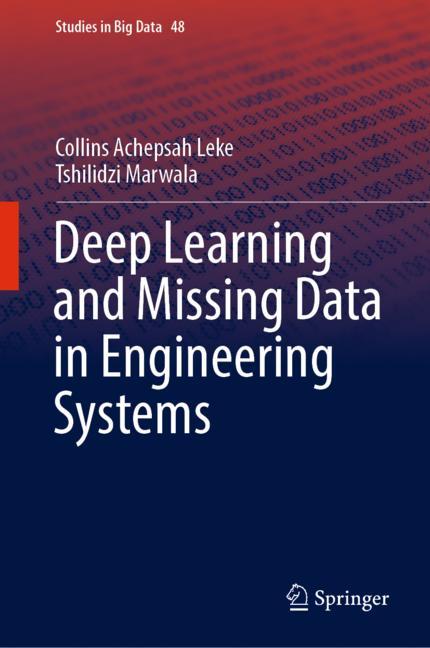
Deep Learning and Missing Data in Engineering Systems
☆☆☆☆☆
(0 reviews)
Lowest price (incl. delivery)
21 464,00 JPY
Typical price2 687,55 PLN
Lowest (90 days)117,69 PLN
Offers6
Last updatedil y a 1 semaine
Price history (90 days)
Full history
2026-08-08
2026-08-15
| Mis à jour le | Prix |
|---|---|
| 2026-08-08 | 117,69 |
| 2026-08-15 | 117,69 |
| Vendeur | Product price | Delivery | Total | Disponibilité | Updated | |
|---|---|---|---|---|---|---|
| SP SpringerNatureLink Shop INT | 21 449,00 JPY | 15,00 JPY | 21 464,00 JPY | Disponible | il y a 3 jours | View offer |
| SP Springer Nature Author | 21 449,00 JPY | free | 21 449,00 JPY | Disponible | il y a 1 semaine | View offer |
| SP SpringerNatureLink Shop INT | 149,99 USD | 15,00 USD | 164,99 USD | Disponible | il y a 3 jours | View offer |
| SP SpringerNatureLink Shop INT | 169,99 USD | 29,00 USD | 198,99 USD | Disponible | il y a 3 jours | View offer |
| SP SpringerNatureLink Shop INT | 169,99 USD | 15,00 USD | 184,99 USD | Disponible | il y a 3 jours | View offer |
| SP SpringerNatureLink Shop INT | 177,00 EUR | 15,00 EUR | 192,00 EUR | Disponible | il y a 3 jours | View offer |
Les prix et la disponibilité peuvent changer. Dernière mise à jour: 08.08.2026 23:28.
0,0
☆☆☆☆☆
0 reviews
5★
0%
4★
0%
3★
0%
2★
0%
1★
0%
Product reviews
No reviews yet — be the first!
Deep Learning and Missing Data in Engineering Systems uses deep learning and swarm intelligence methods to cover missing data estimation in engineering systems. The missing data estimation processes proposed in the book can be applied in image recognition and reconstruction. To facilitate the imputation of missing data, several artificial intelligence approaches are presented, including: deep autoencoder neural networks; deep denoising autoencoder networks; the bat algorithm; the cuckoo search algorithm; and the firefly algorithm. The hybrid models proposed are used to estimate the missing data in high-dimensional data settings more accurately. Swarm intelligence algorithms are applied to address critical questions such as model selection and model parameter estimation. The authors address feature extraction for the purpose of reconstructing the input data from reduced dimensions by the use of deep autoencoder neural networks. They illustrate new models diagrammatically, report their findings in tables, so as to put their methods on a sound statistical basis. The methods proposed speed up the process of data estimation while preserving known features of the data matrix. This book is a valuable source of information for researchers and practitioners in data science. Advanced undergraduate and postgraduate students studying topics in computational intelligence and big data, can also use the book as a reference for identifying and introducing new research thrusts in missing data estimation.
Similar products
 50 Years of Philosophy and Medicine
from $107.30
50 Years of Philosophy and Medicine
from $107.30
 Understanding Cybersecurity Law and Digital Privacy
from $122.63
Understanding Cybersecurity Law and Digital Privacy
from $122.63
 Decisions in International Trade and Logistics
from $122.63
Decisions in International Trade and Logistics
from $122.63
 Advances in Economic Measurement
from $122.63
Advances in Economic Measurement
from $122.63
 Nanomaterials
from $137.96
Nanomaterials
from $137.96
 Sustainable Scaffolds-based Strategies in Tissue Engineering and Regenerative Medicine
from $162.87
Sustainable Scaffolds-based Strategies in Tissue Engineering and Regenerative Medicine
from $162.87
 Narratives in Educational Research
from $162.87
Narratives in Educational Research
from $162.87
 Environmental Biology of the Young Chinese Sturgeon
from $210.78
Environmental Biology of the Young Chinese Sturgeon
from $210.78