
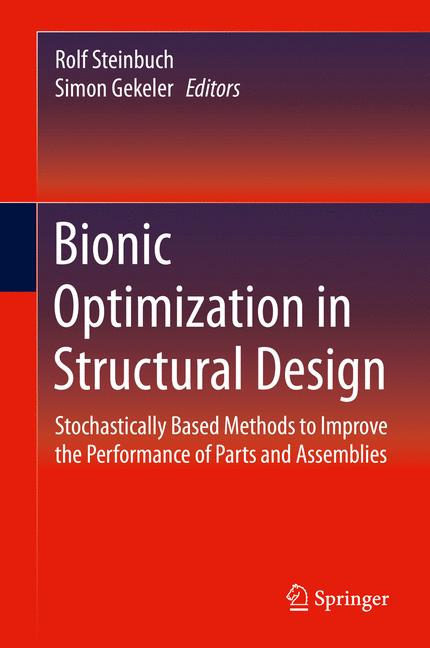
Bionic Optimization in Structural Design
☆☆☆☆☆
(0 reviews)
Lowest price (incl. delivery)
9 176,00 JPY
Typical price2 344,38 PLN
Lowest (90 days)75,50 PLN
Offers2
Last updatedil y a 3 jours
| Vendeur | Product price | Delivery | Total | Disponibilité | Updated | |
|---|---|---|---|---|---|---|
| SP Springer Nature Author | 9 151,00 JPY | 25,00 JPY | 9 176,00 JPY | Disponible | il y a 3 jours | View offer |
| SP SpringerNatureLink Shop INT | 75,50 EUR | free | 75,50 EUR | Disponible | il y a 3 jours | View offer |
Les prix et la disponibilité peuvent changer. Dernière mise à jour: 08.08.2026 23:18.
EAN
9783662465967
Springer Nature
0,0
☆☆☆☆☆
0 reviews
5★
0%
4★
0%
3★
0%
2★
0%
1★
0%
Product reviews
No reviews yet — be the first!
The book provides suggestions on how to start using bionic optimization methods, including pseudo-code examples of each of the important approaches and outlines of how to improve them. The most efficient methods for accelerating the studies are discussed. These include the selection of size and generations of a study’s parameters, modification of these driving parameters, switching to gradient methods when approaching local maxima, and the use of parallel working hardware. Bionic Optimization means finding the best solution to a problem using methods found in nature. As Evolutionary Strategies and Particle Swarm Optimization seem to be the most important methods for structural optimization, we primarily focus on them. Other methods such as neural nets or ant colonies are more suited to control or process studies, so their basic ideas are outlined in order to motivate readers to start using them. A set of sample applications shows how Bionic Optimization works in practice. From academic studies on simple frames made of rods to earthquake-resistant buildings, readers follow the lessons learned, difficulties encountered and effective strategies for overcoming them. For the problem of tuned mass dampers, which play an important role in dynamic control, changing the goal and restrictions paves the way for Multi-Objective-Optimization. As most structural designers today use commercial software such as FE-Codes or CAE systems with integrated simulation modules, ways of integrating Bionic Optimization into these software packages are outlined and examples of typical systems and typical optimization approaches are presented. The closing section focuses on an overview and outlook on reliable and robust as well as on Multi-Objective-Optimization, including discussions of current and upcoming research topics in the field concerning a unified theory for handling stochastic design processes.
Similar products
 Patient Safety Coaching
from $91.97
Patient Safety Coaching
from $91.97
 Ethnography and Diversity
from $69.30
Ethnography and Diversity
from $69.30
 Smart Villages
from $91.97
Smart Villages
from $91.97
 Nuclear Non-Proliferation in International Law - Volume VI
from $91.97
Nuclear Non-Proliferation in International Law - Volume VI
from $91.97
 The Price of Freedom
from $91.97
The Price of Freedom
from $91.97
 Eco-Social Policy in the OECD and the World Bank
from $91.97
Eco-Social Policy in the OECD and the World Bank
from $91.97
 Special Topics in Policing
from $122.58
Special Topics in Policing
from $122.58
 Music from the Heart
from $91.97
Music from the Heart
from $91.97