
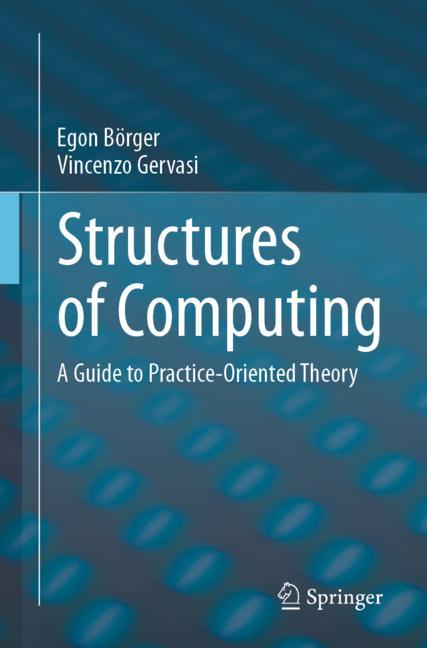
Structures of Computing
☆☆☆☆☆
(0 reviews)
Lowest price (incl. delivery)
74,50 EUR
Typical price704,44 PLN
Lowest (90 days)45,50 PLN
Offers2
Last updatedhace 1 semana
Price history (90 days)
Full history
2026-08-08
2026-08-15
| Actualizado el | Precio |
|---|---|
| 2026-08-08 | 45,50 |
| 2026-08-15 | 45,50 |
| Vendedor | Product price | Delivery | Total | Disponibilidad | Updated | |
|---|---|---|---|---|---|---|
| SP SpringerNatureLink Shop INT | 45,50 EUR | 29,00 EUR | 74,50 EUR | Disponible | hace 6 días | View offer |
| SP Springer Nature Author | 7 864,00 JPY | free | 7 864,00 JPY | Disponible | hace 1 semana | View offer |
Los precios y la disponibilidad pueden cambiar. Última actualización: 08.08.2026 11:46.
EAN
9783031543579
Springer Nature
0,0
☆☆☆☆☆
0 reviews
5★
0%
4★
0%
3★
0%
2★
0%
1★
0%
Product reviews
No reviews yet — be the first!
Structures of Computing explains the behavioral meaning of fundamental concepts of computing from a practical viewpoint and in generic terms, unrestricted by specific computing devices or programming languages. To compute is understood as processing structures by a set of cooperating agents each of which executes an algorithm assigned to it and interacts with the other agents. Part I of the book defines the conceptual constituents of interactive processes: (i) data, i.e. structured objects with associated properties, relations and functions the algorithmic processes operate upon, (ii) basic operations that affect the data in single execution steps, and (iii) control mechanisms that determine the combination of single steps in multi-agent computations where the interaction happens via communication or other forms of data sharing. Part II analyses these constituents concerning (i) methods to achieve process correctness (inspection, experimental validation, reasoning), (ii) principal computational paradigms (architectures, programming styles, communication structures, control patterns from sequential and reflective to concurrent, mixed synchronous/asynchronous and data flow control), and (iii) complexity (power and limits of computing structures). The book is mainly addressed to students and professionals who want to understand the conceptual foundation of computing. It does not assume any specific programming experience but only a basic understanding of what are mechanically executable processes and their descriptions. Any unnecessary formalism is thus avoided, and definitions are formulated as much as possible in natural language, using common mathematical notation only where needed to prevent ambiguities. Numerous examples and exercises serve as comprehension checkpoints.
Similar products
 50 Years of Philosophy and Medicine
from $107.30
50 Years of Philosophy and Medicine
from $107.30
 Understanding Cybersecurity Law and Digital Privacy
from $122.63
Understanding Cybersecurity Law and Digital Privacy
from $122.63
 Decisions in International Trade and Logistics
from $122.63
Decisions in International Trade and Logistics
from $122.63
 Advances in Economic Measurement
from $122.63
Advances in Economic Measurement
from $122.63
 Nanomaterials
from $137.96
Nanomaterials
from $137.96
 Sustainable Scaffolds-based Strategies in Tissue Engineering and Regenerative Medicine
from $162.87
Sustainable Scaffolds-based Strategies in Tissue Engineering and Regenerative Medicine
from $162.87
 Narratives in Educational Research
from $162.87
Narratives in Educational Research
from $162.87
 Environmental Biology of the Young Chinese Sturgeon
from $210.78
Environmental Biology of the Young Chinese Sturgeon
from $210.78