
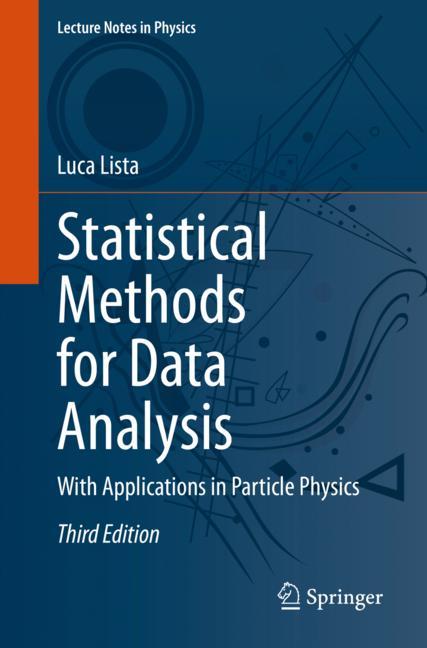
Statistical Methods for Data Analysis
☆☆☆☆☆
(0 reviews)
Lowest price (incl. delivery)
10 724,00 JPY
Typical price792,16 PLN
Lowest (90 days)56,17 PLN
Offers3
Last updatedhace 1 día
| Vendedor | Product price | Delivery | Total | Disponibilidad | Updated | |
|---|---|---|---|---|---|---|
| SP Springer Nature Author | 10 724,00 JPY | free | 10 724,00 JPY | Disponible | hace 7 horas | View offer |
| SP SpringerNatureLink Shop INT | 82,49 EUR | 19,00 EUR | 101,49 EUR | Disponible | hace 17 horas | View offer |
| VI VitalSource | 483,85 ZAR | free | 483,85 ZAR | Disponible | hace 1 día | View offer |
Los precios y la disponibilidad pueden cambiar. Última actualización: 08.08.2026 06:08.
EAN
9783031199332
Springer Nature
0,0
☆☆☆☆☆
0 reviews
5★
0%
4★
0%
3★
0%
2★
0%
1★
0%
Product reviews
No reviews yet — be the first!
This third edition expands on the original material. Large portions of the text have been reviewed and clarified. More emphasis is devoted to machine learning including more modern concepts and examples. This book provides the reader with the main concepts and tools needed to perform statistical analyses of experimental data, in particular in the field of high-energy physics (HEP). It starts with an introduction to probability theory and basic statistics, mainly intended as a refresher from readers’ advanced undergraduate studies, but also to help them clearly distinguish between the Frequentist and Bayesian approaches and interpretations in subsequent applications. Following, the author discusses Monte Carlo methods with emphasis on techniques like Markov Chain Monte Carlo, and the combination of measurements, introducing the best linear unbiased estimator. More advanced concepts and applications are gradually presented, including unfolding and regularization procedures, culminating in the chapter devoted to discoveries and upper limits. The reader learns through many applications in HEP where the hypothesis testing plays a major role and calculations of look-elsewhere effect are also presented. Many worked-out examples help newcomers to the field and graduate students alike understand the pitfalls involved in applying theoretical concepts to actual data.
Similar products
 Patient Safety Coaching
from $91.97
Patient Safety Coaching
from $91.97
 Ethnography and Diversity
from $69.30
Ethnography and Diversity
from $69.30
 Smart Villages
from $91.97
Smart Villages
from $91.97
 Nuclear Non-Proliferation in International Law - Volume VI
from $91.97
Nuclear Non-Proliferation in International Law - Volume VI
from $91.97
 The Price of Freedom
from $91.97
The Price of Freedom
from $91.97
 Eco-Social Policy in the OECD and the World Bank
from $91.97
Eco-Social Policy in the OECD and the World Bank
from $91.97
 Special Topics in Policing
from $122.58
Special Topics in Policing
from $122.58
 Music from the Heart
from $91.97
Music from the Heart
from $91.97