
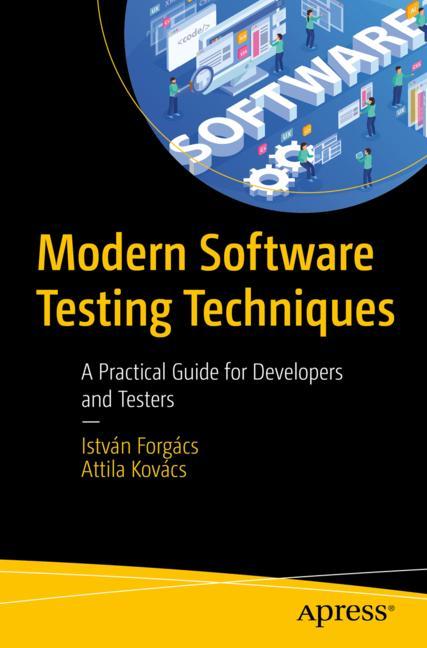
Modern Software Testing Techniques
☆☆☆☆☆
(0 reviews)
Lowest price (incl. delivery)
29,75 EUR
Typical price26,42 PLN
Lowest (90 days)22,39 PLN
Offers2
Last updatedhace 16 horas
| Vendedor | Product price | Delivery | Total | Disponibilidad | Updated | |
|---|---|---|---|---|---|---|
| SP SpringerNatureLink Shop INT | 29,75 EUR | free | 29,75 EUR | Disponible | hace 1 día | View offer |
| SP Springer Nature Author | 29,75 EUR | 29,00 EUR | 58,75 EUR | Disponible | hace 16 horas | View offer |
Los precios y la disponibilidad pueden cambiar. Última actualización: 08.08.2026 20:16.
EAN
9781484298930
Springer Nature
0,0
☆☆☆☆☆
0 reviews
5★
0%
4★
0%
3★
0%
2★
0%
1★
0%
Product reviews
No reviews yet — be the first!
Many books have been written about software testing, but most of them discuss the general framework of testing from a traditional perspective. Unfortunately, traditional test design techniques are often ineffective and unreliable for revealing the various kinds of faults that may occur. This book introduces three new software testing techniques: Two-Phase Model-Based Testing, the Action-State Testing, and the General Predicate Testing, all of which work best when applied with efficient fault revealing capabilities. You’ll start with a short recap of software testing, focusing on why risk analysis is obligatory, how to classify bugs practically, and how fault-based testing can be used for improving test design. You’ll then see how action-state testing merges the benefits of state transition testing and use case testing into a unified approach. Moving on you’ll look at general predicate testing and how it serves as an extension of boundary value analysis, encompassing morecomplex predicates. Two-phase model-based testing represents an advanced approach where the model does not necessarily need to be machine-readable; human readability suffices. The first phase involves a high-level model from which abstract tests are generated. Upon manual execution of these tests, the test code is generated. Rather than calculating output values, they are merely checked for conformity. The last part of this book contains a chapter on how developers and testers can help each other and work as a collaborative team. What You'll Learn Apply efficient test design techniques for detecting domain faults Work with modeling techniques that combine all the advantages of state transition testing and uses case testing Grasp the two-phase model-based testing technique Use test design efficiently to find almost all the bugs in an application Who This Book Is For Software developers, QA engineers, and, business analysts
Similar products
 Patient Safety Coaching
from $91.97
Patient Safety Coaching
from $91.97
 Ethnography and Diversity
from $69.30
Ethnography and Diversity
from $69.30
 Smart Villages
from $91.97
Smart Villages
from $91.97
 Nuclear Non-Proliferation in International Law - Volume VI
from $91.97
Nuclear Non-Proliferation in International Law - Volume VI
from $91.97
 The Price of Freedom
from $91.97
The Price of Freedom
from $91.97
 Eco-Social Policy in the OECD and the World Bank
from $91.97
Eco-Social Policy in the OECD and the World Bank
from $91.97
 Special Topics in Policing
from $122.58
Special Topics in Policing
from $122.58
 Music from the Heart
from $91.97
Music from the Heart
from $91.97