
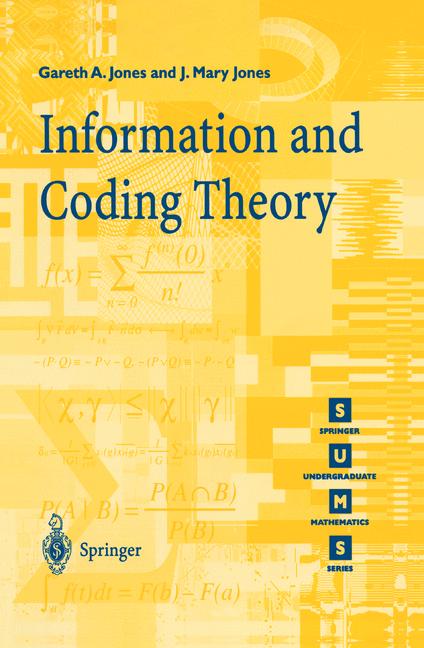
Information and Coding Theory
☆☆☆☆☆
(0 reviews)
Lowest price (incl. delivery)
54,75 EUR
Typical price667,13 PLN
Lowest (90 days)22,39 PLN
Offers3
Last updatedhace 1 semana
Price history (90 days)
Full history
2026-08-08
2026-08-14
| Actualizado el | Precio |
|---|---|
| 2026-08-08 | 26,21 |
| 2026-08-14 | 22,39 |
| Vendedor | Product price | Delivery | Total | Disponibilidad | Updated | |
|---|---|---|---|---|---|---|
| SP SpringerNatureLink Shop INT | 29,75 EUR | 25,00 EUR | 54,75 EUR | Disponible | hace 1 semana | View offer |
| SP SpringerNatureLink Shop INT | 5 147,00 JPY | free | 5 147,00 JPY | Disponible | hace 6 días | View offer |
| SP Springer Nature Author | 5 147,00 JPY | 19,00 JPY | 5 166,00 JPY | Disponible | hace 1 semana | View offer |
Los precios y la disponibilidad pueden cambiar. Última actualización: 08.08.2026 23:06.
EAN
9781447103615
Springer Nature
0,0
☆☆☆☆☆
0 reviews
5★
0%
4★
0%
3★
0%
2★
0%
1★
0%
Product reviews
No reviews yet — be the first!
As this Preface is being written, the twentieth century is coming to an end. Historians may perhaps come to refer to it as the century of information, just as its predecessor is associated with the process of industrialisation. Successive technological developments such as the telephone, radio, television, computers and the Internet have had profound effects on the way we live. We can see pic tures of the surface of Mars or the early shape of the Universe. The contents of a whole shelf-load of library books can be compressed onto an almost weight less piece of plastic. Billions of people can watch the same football match, or can keep in instant touch with friends around the world without leaving home. In short, massive amounts of information can now be stored, transmitted and processed, with surprising speed, accuracy and economy. Of course, these developments do not happen without some theoretical ba sis, and as is so often the case, much of this is provided by mathematics. Many of the first mathematical advances in this area were made in the mid-twentieth century by engineers, often relying on intuition and experience rather than a deep theoretical knowledge to lead them to their discoveries. Soon the math ematicians, delighted to see new applications for their subject, joined in and developed the engineers' practical examples into wide-ranging theories, com plete with definitions, theorems and proofs.
Similar products
 50 Years of Philosophy and Medicine
from $107.30
50 Years of Philosophy and Medicine
from $107.30
 Understanding Cybersecurity Law and Digital Privacy
from $122.63
Understanding Cybersecurity Law and Digital Privacy
from $122.63
 Decisions in International Trade and Logistics
from $122.63
Decisions in International Trade and Logistics
from $122.63
 Advances in Economic Measurement
from $122.63
Advances in Economic Measurement
from $122.63
 Nanomaterials
from $137.96
Nanomaterials
from $137.96
 Sustainable Scaffolds-based Strategies in Tissue Engineering and Regenerative Medicine
from $162.87
Sustainable Scaffolds-based Strategies in Tissue Engineering and Regenerative Medicine
from $162.87
 Narratives in Educational Research
from $162.87
Narratives in Educational Research
from $162.87
 Environmental Biology of the Young Chinese Sturgeon
from $210.78
Environmental Biology of the Young Chinese Sturgeon
from $210.78