
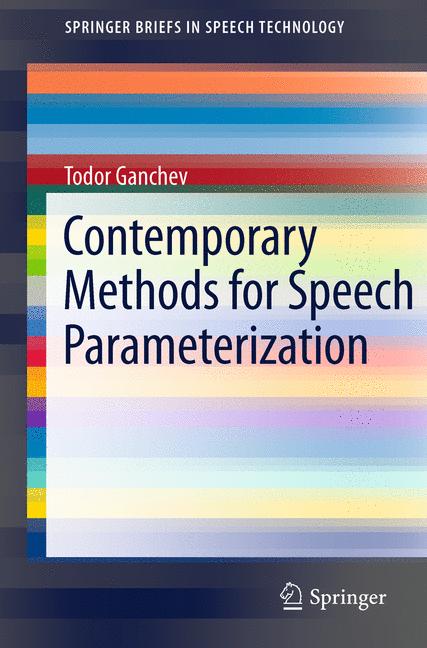
Contemporary Methods for Speech Parameterization
☆☆☆☆☆
(0 reviews)
Lowest price (incl. delivery)
7 168,00 JPY
Typical price228,36 PLN
Lowest (90 days)18,78 PLN
Offers3
Last updatedhace 1 día
Price history (90 days)
Full history
2026-08-07
2026-08-08
| Actualizado el | Precio |
|---|---|
| 2026-08-07 | 18,78 |
| 2026-08-08 | 49,95 |
| Vendedor | Product price | Delivery | Total | Disponibilidad | Updated | |
|---|---|---|---|---|---|---|
| SP Springer Nature Author | 7 143,00 JPY | 25,00 JPY | 7 168,00 JPY | Disponible | hace 14 horas | View offer |
| VI VitalSource | 256,16 ZAR | 25,00 ZAR | 281,16 ZAR | Disponible | hace 1 día | View offer |
| SP SpringerNatureLink Shop INT | 72,14 EUR | 29,00 EUR | 101,14 EUR | Disponible | hace 1 día | View offer |
Los precios y la disponibilidad pueden cambiar. Última actualización: 08.08.2026 12:08.
EAN
9781441984463
Springer Nature
0,0
☆☆☆☆☆
0 reviews
5★
0%
4★
0%
3★
0%
2★
0%
1★
0%
Product reviews
No reviews yet — be the first!
Contemporary Methods for Speech Parameterization offers a general view of short-time cepstrum-based speech parameterization and provides a common ground for further in-depth studies on the subject. Specifically, it offers a comprehensive description, comparative analysis, and empirical performance evaluation of eleven contemporary speech parameterization methods, which compute short-time cepstrum-based speech features. Among these are five discrete wavelet packet transform (DWPT)-based, six discrete Fourier transform (DFT)-based speech features and some of their variants which have been used on the speech recognition, speaker recognition, and other related speech processing tasks. The main similarities and differences in their computation are discussed and empirical results from performance evaluation in common experimental conditions are presented. The recognition accuracy obtained on the monophone recognition, continuous speech recognition and speaker recognition tasks is contrasted against the one obtained for the well-known and widely used Mel Frequency Cepstral Coefficients (MFCC). It is shown that many of these methods lead to speech features that do offer competitive performance on a certain speech processing setup when compared to the venerable MFCC. The last does not target the promotion of certain speech features but instead aims to enhance the common understanding about the advantages and disadvantages of the various speech parameterization techniques available today and to provide the basis for selection of an appropriate speech parameterization in each particular case.
Similar products
 Patient Safety Coaching
from $91.97
Patient Safety Coaching
from $91.97
 Ethnography and Diversity
from $69.30
Ethnography and Diversity
from $69.30
 Smart Villages
from $91.97
Smart Villages
from $91.97
 Nuclear Non-Proliferation in International Law - Volume VI
from $91.97
Nuclear Non-Proliferation in International Law - Volume VI
from $91.97
 The Price of Freedom
from $91.97
The Price of Freedom
from $91.97
 Eco-Social Policy in the OECD and the World Bank
from $91.97
Eco-Social Policy in the OECD and the World Bank
from $91.97
 Special Topics in Policing
from $122.58
Special Topics in Policing
from $122.58
 Music from the Heart
from $91.97
Music from the Heart
from $91.97