
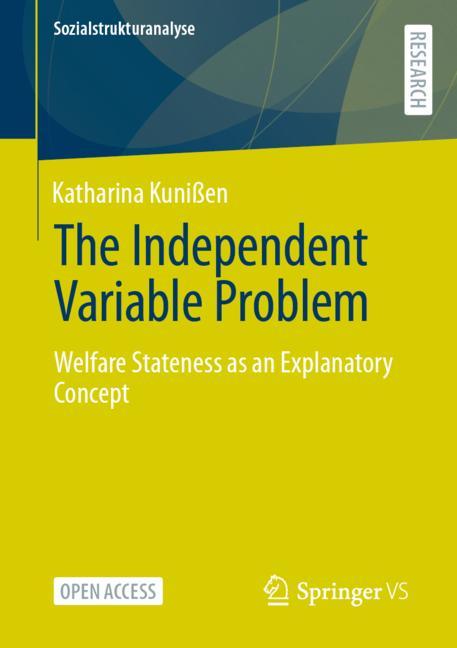
The Independent Variable Problem
☆☆☆☆☆
(0 reviews)
Lowest price (incl. delivery)
5 719,00 JPY
Typical price2 053,26 PLN
Lowest (90 days)34,99 PLN
Offers6
Last updatedvor 1 Woche
Price history (90 days)
Full history
2026-08-08
2026-08-15
| Aktualisiert am | Preis |
|---|---|
| 2026-08-08 | 39,99 |
| 2026-08-14 | 34,99 |
| 2026-08-15 | 5 719,00 |
| Verkäufer | Product price | Delivery | Gesamt | Verfügbarkeit | Updated | |
|---|---|---|---|---|---|---|
| SP SpringerNatureLink Shop INT | 5 719,00 JPY | free | 5 719,00 JPY | Verfügbar | vor 5 Tagen | View offer |
| SP Springer Nature Author | 5 719,00 JPY | 19,00 JPY | 5 738,00 JPY | Verfügbar | vor 1 Woche | View offer |
| SP SpringerNatureLink Shop INT | 39,99 USD | 29,00 USD | 68,99 USD | Verfügbar | vor 5 Tagen | View offer |
| SP SpringerNatureLink Shop INT | 43,99 EUR | 15,00 EUR | 58,99 EUR | Verfügbar | vor 5 Tagen | View offer |
| SP SpringerNatureLink Shop INT | 49,99 USD | 19,00 USD | 68,99 USD | Verfügbar | vor 5 Tagen | View offer |
| SP SpringerNatureLink Shop INT | 49,99 USD | 15,00 USD | 64,99 USD | Verfügbar | vor 5 Tagen | View offer |
Preise und Verfügbarkeit können sich ändern. Zuletzt aktualisiert: 08.08.2026 23:09.
0,0
☆☆☆☆☆
0 reviews
5★
0%
4★
0%
3★
0%
2★
0%
1★
0%
Product reviews
No reviews yet — be the first!
This open access publication deals with the operationalisation of the welfare state as an independent variable. To study how welfare states affect social inequality, individual behaviour, attitudes and more in different countries, an empirical operationalisation of the welfare state or specific elements of social policy is required. However, this operationalisation is fraught with some important problems. These problems essentially relate to one point: while there are a large number of contributions dealing with the measurement of differences between welfare states per se and as a dependent variable, there is a lack of feasible recommendations for a standardised operationalisation of welfare stateness as an independent variable. So far, there has been no systematic investigation of how such different approaches may affect the results and their comparability. Also missing is an in-depth conceptual discussion of which features of the welfare state are particularly relevant for explaining certain effects. This book fills both gaps. First, it exposes the pitfalls of existing approaches and shows how much empirical results can vary depending on the operationalisation chosen. Second, it proposes a framework for a standardised conceptualisation and operationalisation of social policies as independent variables that constrains operational decisions in a theoretically meaningful way.
Similar products
 50 Years of Philosophy and Medicine
from $107.30
50 Years of Philosophy and Medicine
from $107.30
 Understanding Cybersecurity Law and Digital Privacy
from $122.63
Understanding Cybersecurity Law and Digital Privacy
from $122.63
 Decisions in International Trade and Logistics
from $122.63
Decisions in International Trade and Logistics
from $122.63
 Advances in Economic Measurement
from $122.63
Advances in Economic Measurement
from $122.63
 Nanomaterials
from $137.96
Nanomaterials
from $137.96
 Sustainable Scaffolds-based Strategies in Tissue Engineering and Regenerative Medicine
from $162.87
Sustainable Scaffolds-based Strategies in Tissue Engineering and Regenerative Medicine
from $162.87
 Narratives in Educational Research
from $162.87
Narratives in Educational Research
from $162.87
 Environmental Biology of the Young Chinese Sturgeon
from $210.78
Environmental Biology of the Young Chinese Sturgeon
from $210.78