
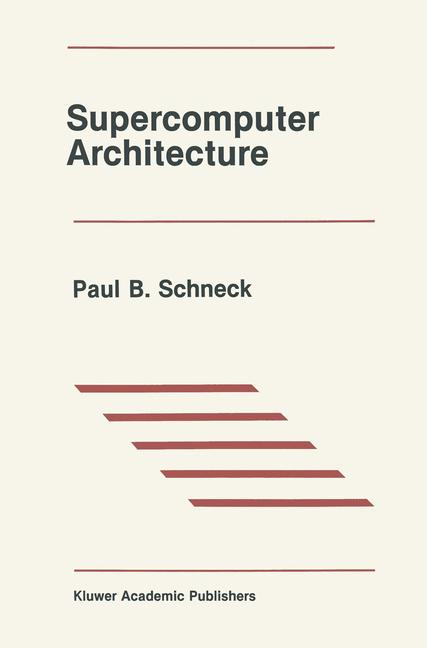
Supercomputer Architecture
☆☆☆☆☆
(0 reviews)
Lowest price (incl. delivery)
7 149,00 JPY
Typical price151,11 PLN
Lowest (90 days)44,99 PLN
Offers6
Last updatedvor 6 Tagen
Price history (90 days)
Full history
2026-08-08
2026-08-15
| Aktualisiert am | Preis |
|---|---|
| 2026-08-08 | 44,99 |
| 2026-08-14 | 44,99 |
| 2026-08-15 | 52,74 |
| Verkäufer | Product price | Delivery | Gesamt | Verfügbarkeit | Updated | |
|---|---|---|---|---|---|---|
| SP Springer Nature Author | 7 149,00 JPY | free | 7 149,00 JPY | Verfügbar | vor 6 Tagen | View offer |
| SP SpringerNatureLink Shop INT | 49,99 USD | 29,00 USD | 78,99 USD | Verfügbar | vor 5 Stunden | View offer |
| SP SpringerNatureLink Shop INT | 49,99 USD | free | 49,99 USD | Verfügbar | vor 5 Stunden | View offer |
| SP SpringerNatureLink Shop INT | 54,99 USD | free | 54,99 USD | Verfügbar | vor 4 Stunden | View offer |
| SP SpringerNatureLink Shop INT | 54,99 USD | 25,00 USD | 79,99 USD | Verfügbar | vor 4 Stunden | View offer |
| SP SpringerNatureLink Shop INT | 59,00 EUR | 29,00 EUR | 88,00 EUR | Verfügbar | vor 3 Stunden | View offer |
Preise und Verfügbarkeit können sich ändern. Zuletzt aktualisiert: 08.08.2026 23:11.
0,0
☆☆☆☆☆
0 reviews
5★
0%
4★
0%
3★
0%
2★
0%
1★
0%
Product reviews
No reviews yet — be the first!
Supercomputers are the largest and fastest computers available at any point in time. The term was used for the first time in the New York World, March 1920, to describe "new statistical machines with the mental power of 100 skilled mathematicians in solving even highly complex algebraic problems. " Invented by Mendenhall and Warren, these machines were used at Columbia University'S Statistical Bureau. Recently, supercomputers have been used primarily to solve large-scale prob lems in science and engineering. Solutions of systems of partial differential equa tions, such as those found in nuclear physics, meteorology, and computational fluid dynamics, account for the majority of supercomputer use today. The early computers, such as EDVAC, SSEC, 701, and UNIVAC, demonstrated the feasibility of building fast electronic computing machines which could become commercial products. The next generation of computers focused on attaining the highest possible computational speeds. This book discusses the architectural approaches used to yield significantly higher computing speeds while preserving the conventional, von Neumann, machine organization (Chapters 2-4). Subsequent improvements depended on developing a new generation of computers employing a new model of computation: single-instruction multiple data (SIMD) processors (Chapters 5-7). Later machines refmed SIMD architec ture and technology (Chapters 8-9). SUPERCOMPUTER ARCHITECI'URE CHAPTER! INTRODUCTION THREE ERAS OF SUPERCOMPUTERS Supercomputers -- the largest and fastest computers available at any point in time -- have been the products of complex interplay among technological, architectural, and algorithmic developments.
Similar products
 Climate Crisis and Changing Population Dynamics
from $128.39
Climate Crisis and Changing Population Dynamics
from $128.39
 Chapters in Education: Volume 1
from $128.39
Chapters in Education: Volume 1
from $128.39
 Human Centred Design for Systems
from $128.39
Human Centred Design for Systems
from $128.39
 Advancing the Green Agenda in the Transport and Logistics Sector in Global South Countries
from $128.39
Advancing the Green Agenda in the Transport and Logistics Sector in Global South Countries
from $128.39
 Narratives of Crisis and Futurity
from $128.39
Narratives of Crisis and Futurity
from $128.39
 AI-IoT for Smart Urban Planning and Sustainable Development
from $128.39
AI-IoT for Smart Urban Planning and Sustainable Development
from $128.39
 Clinical Hematology and Hemato-Oncology
from $128.39
Clinical Hematology and Hemato-Oncology
from $128.39
 Smart Hydrogels and Ferrogels
from $128.39
Smart Hydrogels and Ferrogels
from $128.39