
Space-Time Point Processes
☆☆☆☆☆
(0 reviews)
Lowest price (incl. delivery)
12 612,00 JPY
Typical price4 260,94 PLN
Lowest (90 days)79,50 PLN
Offers2
Last updatedvor 1 Tag
| Verkäufer | Product price | Delivery | Gesamt | Verfügbarkeit | Updated | |
|---|---|---|---|---|---|---|
| SP Springer Nature Author | 12 583,00 JPY | 29,00 JPY | 12 612,00 JPY | Verfügbar | vor 1 Tag | View offer |
| SP SpringerNatureLink Shop INT | 104,00 EUR | 29,00 EUR | 133,00 EUR | Verfügbar | vor 1 Tag | View offer |
Preise und Verfügbarkeit können sich ändern. Zuletzt aktualisiert: 08.08.2026 23:21.
EAN
9783032207906
Springer Nature
0,0
☆☆☆☆☆
0 reviews
5★
0%
4★
0%
3★
0%
2★
0%
1★
0%
Product reviews
No reviews yet — be the first!
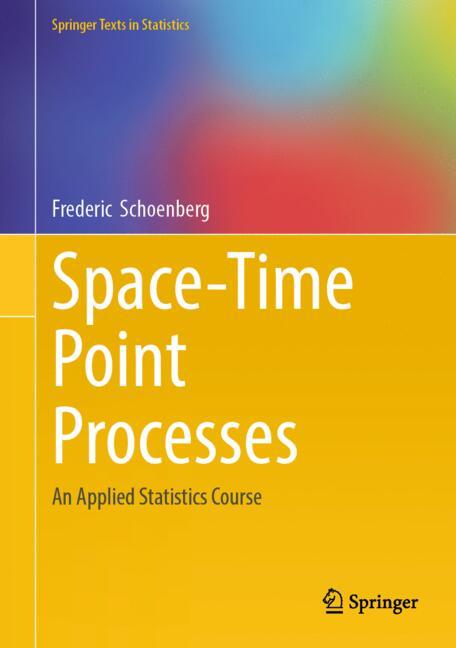
The book focuses on applied methodology, and summarizes the main issues in the practical applications associated with space-time point processes. In particular, the questions addressed in this book are: How can one summarize space-time point process data? How are space-time point processes modeled? What are the different ways of estimating parameters in space-time point process models, and how do they compare? How can space-time point process models be estimated non-parametrically? What techniques exist for assessing how well a space-time point process model fits to data, or for comparing the fit of multiple models? How can one use a space-time point process model to forecast the probability of future events? Applied examples are used throughout the book, and the text includes R code for implementing all the techniques discussed in the book. The book covers standard, classical methods for point processes, such as Poisson processes, Cox processes, Neyman-Scott processes, Hawkes models, conditional intensities, kernel smoothing, and Ripley's K-function, and also describes important recent advances for space-time point processes, such as Model-Independent Stochastic Declustering (MISD), Stoyan-Grabarnik parameter estimation, Voronoi deviance residuals, and super-thinned residuals. The book is meant to be used for teaching at the graduate or undergraduate levels. Sample exercises are given at the end of each chapter, and these problems are not too difficult and thus suitable for undergraduate or graduate students in applied statistics. The goal is to educate and train students in the practical aspects of the summary, description and forecasting of spatial-temporal point process data.
Similar products
 Patient Safety Coaching
from $91.97
Patient Safety Coaching
from $91.97
 Ethnography and Diversity
from $69.30
Ethnography and Diversity
from $69.30
 Smart Villages
from $91.97
Smart Villages
from $91.97
 Nuclear Non-Proliferation in International Law - Volume VI
from $91.97
Nuclear Non-Proliferation in International Law - Volume VI
from $91.97
 The Price of Freedom
from $91.97
The Price of Freedom
from $91.97
 Eco-Social Policy in the OECD and the World Bank
from $91.97
Eco-Social Policy in the OECD and the World Bank
from $91.97
 Special Topics in Policing
from $122.58
Special Topics in Policing
from $122.58
 Music from the Heart
from $91.97
Music from the Heart
from $91.97