
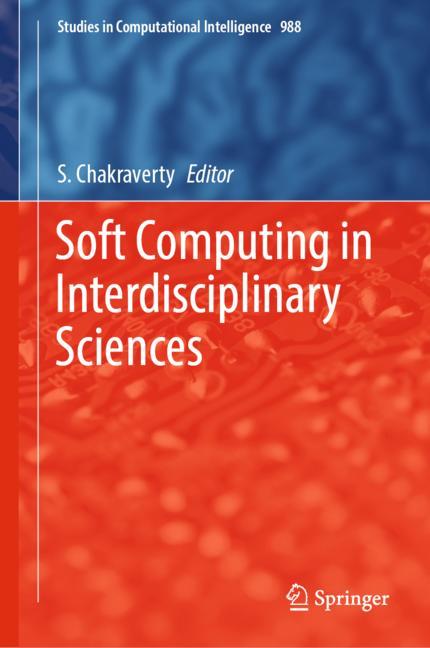
Soft Computing in Interdisciplinary Sciences
☆☆☆☆☆
(0 reviews)
Lowest price (incl. delivery)
24 328,00 JPY
Typical price2 363,00 PLN
Lowest (90 days)56,70 PLN
Offers2
Last updatedvor 1 Tag
| Verkäufer | Product price | Delivery | Gesamt | Verfügbarkeit | Updated | |
|---|---|---|---|---|---|---|
| SP Springer Nature Author | 24 309,00 JPY | 19,00 JPY | 24 328,00 JPY | Verfügbar | vor 1 Tag | View offer |
| VI VitalSource | 171,19 EUR | free | 171,19 EUR | Verfügbar | vor 2 Tagen | View offer |
Preise und Verfügbarkeit können sich ändern. Zuletzt aktualisiert: 08.08.2026 22:49.
EAN
9789811647123
Springer Nature
0,0
☆☆☆☆☆
0 reviews
5★
0%
4★
0%
3★
0%
2★
0%
1★
0%
Product reviews
No reviews yet — be the first!
This book meets the present and future needs for the interaction between various science and technology/engineering areas on the one hand and different branches of soft computing on the other. Soft computing is the recent development about the computing methods which include fuzzy set theory/logic, evolutionary computation (EC), probabilistic reasoning, artificial neural networks, machine learning, expert systems, etc. Soft computing refers to a partnership of computational techniques in computer science, artificial intelligence, machine learning, and some other engineering disciplines, which attempt to study, model, and analyze complex problems from different interdisciplinary problems. This, as opposed to traditional computing, deals with approximate models and gives solutions to complex real-life problems. Unlike hard computing, soft computing is tolerant of imprecision, uncertainty, partial truth, and approximations. Interdisciplinary sciences includevarious challenging problems of science and engineering. Recent developments in soft computing are the bridge to handle different interdisciplinary science and engineering problems. In recent years, the correspondingly increased dialog between these disciplines has led to this new book. This is done, firstly, by encouraging the ways that soft computing may be applied in traditional areas, as well as point towards new and innovative areas of applications and secondly, by encouraging other scientific disciplines to engage in a dialog with the above computation algorithms outlining their problems to both access new methods as well as to suggest innovative developments within itself.