
Robot Operating System (ROS)
☆☆☆☆☆
(0 reviews)
Lowest price (incl. delivery)
24 324,00 JPY
Typical price2 229,90 PLN
Lowest (90 days)48,72 PLN
Offers4
Last updatedvor 1 Woche
Price history (90 days)
Full history
2026-08-08
2026-08-15
| Aktualisiert am | Preis |
|---|---|
| 2026-08-08 | 48,72 |
| 2026-08-15 | 185,29 |
| Verkäufer | Product price | Delivery | Gesamt | Verfügbarkeit | Updated | |
|---|---|---|---|---|---|---|
| SP SpringerNatureLink Shop INT | 24 309,00 JPY | 15,00 JPY | 24 324,00 JPY | Verfügbar | vor 5 Tagen | View offer |
| SP Springer Nature Author | 24 309,00 JPY | 25,00 JPY | 24 334,00 JPY | Verfügbar | vor 1 Woche | View offer |
| VI VitalSource | 677,40 ZAR | free | 677,40 ZAR | Verfügbar | vor 1 Woche | View offer |
| SP SpringerNatureLink Shop INT | 201,00 EUR | free | 201,00 EUR | Verfügbar | vor 5 Tagen | View offer |
Preise und Verfügbarkeit können sich ändern. Zuletzt aktualisiert: 08.08.2026 22:49.
EAN
9783319915890
Springer Nature
0,0
☆☆☆☆☆
0 reviews
5★
0%
4★
0%
3★
0%
2★
0%
1★
0%
Product reviews
No reviews yet — be the first!
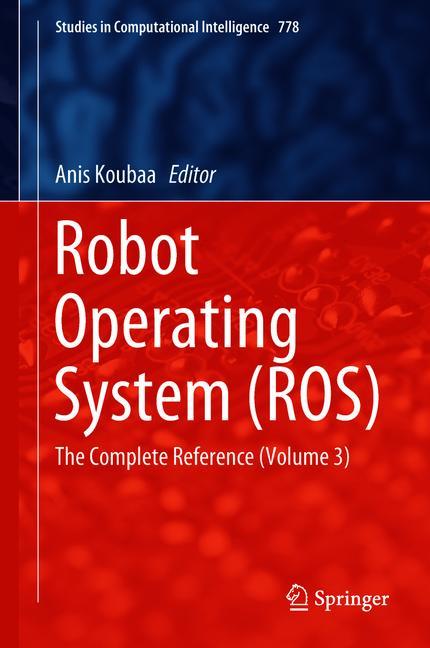
Building on the successful first and second volumes, this book is the third volume of the Springer book on the Robot Operating System (ROS): The Complete Reference. The Robot Operating System is evolving from year to year with a wealth of new contributed packages and enhanced capabilities. Further, the ROS is being integrated into various robots and systems and is becoming an embedded technology in emerging robotics platforms. The objective of this third volume is to provide readers with additional and comprehensive coverage of the ROS and an overview of the latest achievements, trends and packages developed with and for it. Combining tutorials, case studies, and research papers, the book consists of sixteen chapters and is divided into five parts. Part 1 presents multi-robot systems with the ROS. In Part 2, four chapters deal with the development of unmanned aerial systems and their applications. In turn, Part 3 highlights recent work related to navigation, motion planning and control. Part 4 discusses recently contributed ROS packages for security, ROS2, GPU usage, and real-time processing. Lastly, Part 5 deals with new interfaces allowing users to interact with robots. Taken together, the three volumes of this book offer a valuable reference guide for ROS users, researchers, learners and developers alike. Its breadth of coverage makes it a unique resource.
Similar products
 50 Years of Philosophy and Medicine
from $107.30
50 Years of Philosophy and Medicine
from $107.30
 Understanding Cybersecurity Law and Digital Privacy
from $122.63
Understanding Cybersecurity Law and Digital Privacy
from $122.63
 Decisions in International Trade and Logistics
from $122.63
Decisions in International Trade and Logistics
from $122.63
 Advances in Economic Measurement
from $122.63
Advances in Economic Measurement
from $122.63
 Nanomaterials
from $137.96
Nanomaterials
from $137.96
 Sustainable Scaffolds-based Strategies in Tissue Engineering and Regenerative Medicine
from $162.87
Sustainable Scaffolds-based Strategies in Tissue Engineering and Regenerative Medicine
from $162.87
 Narratives in Educational Research
from $162.87
Narratives in Educational Research
from $162.87
 Environmental Biology of the Young Chinese Sturgeon
from $210.78
Environmental Biology of the Young Chinese Sturgeon
from $210.78