
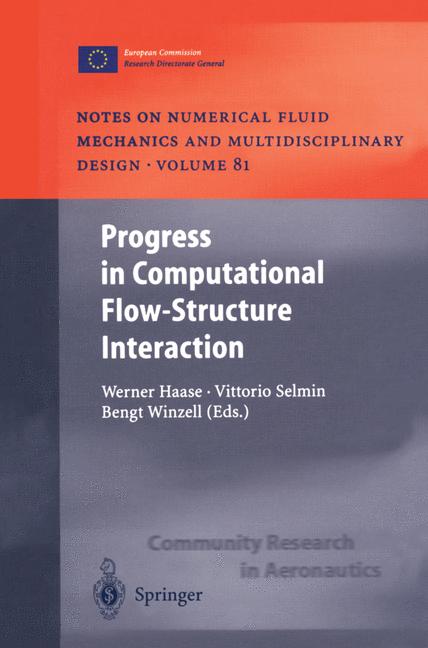
Progress in Computational Flow-Structure Interaction
☆☆☆☆☆
(0 reviews)
Lowest price (incl. delivery)
28 599,00 JPY
Typical price4 949,49 PLN
Lowest (90 days)207,99 PLN
Offers1
Last updatedvor 2 Tagen
| Verkäufer | Product price | Delivery | Gesamt | Verfügbarkeit | Updated | |
|---|---|---|---|---|---|---|
| SP Springer Nature Author | 28 599,00 JPY | free | 28 599,00 JPY | Verfügbar | vor 2 Tagen | View offer |
Preise und Verfügbarkeit können sich ändern. Zuletzt aktualisiert: 08.08.2026 23:38.
0,0
☆☆☆☆☆
0 reviews
5★
0%
4★
0%
3★
0%
2★
0%
1★
0%
Product reviews
No reviews yet — be the first!
Aircraft design processes require extensive work in the area of both aerodynamics and structure, fonning an environment for aeroelasticity investigations. Present and future designs of European aircraft are characterized by an ever increasing aircraft size and perfonnance. Strong weight saving requirements are met by introduction of new materials, leading to more flexible structure of the aircraft. Consequently, aeroelastic phenomena such as vortex-induced aeroelastic oscillations and moving shock waves can be predominant and may have a significant effect on the aircraft perfonnance. Hence, the ability to estimate reliable margins for aeroelastic instabilities (flutter) or dynamic loads (buffeting) is a major concern to the aircraft designer. As modern aircrafts have wing bending modes with frequencies that are low enough to influence the flight control system, demands on unsteady aerodynamics and structural analysis to predict flight control effectiveness and riding comfort for passengers are extremely high. Therefore, the aircraft industries need an improved capacity of robust, accurate and reliable prediction methods in the coupled aeroelastic, flight mechanics and loads disciplines. In particular, it is necessary to develop/improve and calibrate the numerical tools in order to predict with high level of accuracy and capability complex and non-classical aeroelastic phenomena, including aerodynamic non-linearities, such as shock waves and separation, as well as structural non-linearities, e. g. control surface free-play. Nowadays, robust methods for structural analysis and linearised unsteady aerodynamics are coupled and used by the aircraft industry to computationally clear a new design from flutter.
Similar products
 Gamma Knife Neurosurgery in the Management of Intracranial Disorders
from $210.78
Gamma Knife Neurosurgery in the Management of Intracranial Disorders
from $210.78
 SDGs in Construction Economics and Organization
from $210.78
SDGs in Construction Economics and Organization
from $210.78
 Emerging Therapies in Neurorehabilitation III
from $210.78
Emerging Therapies in Neurorehabilitation III
from $210.78
 Ground Improvement Techniques
from $220.36
Ground Improvement Techniques
from $220.36
 Anomaly Detection in Video Surveillance
from $220.36
Anomaly Detection in Video Surveillance
from $220.36
 Mechanism and Machine Science
from $287.42
Mechanism and Machine Science
from $287.42
 Protein-Protein Interactions as New Drug Targets
from $287.42
Protein-Protein Interactions as New Drug Targets
from $287.42
 Proceedings of the 7th International Conference of Transportation Research Group of India (CTRG 2023
from $287.42
Proceedings of the 7th International Conference of Transportation Research Group of India (CTRG 2023
from $287.42