
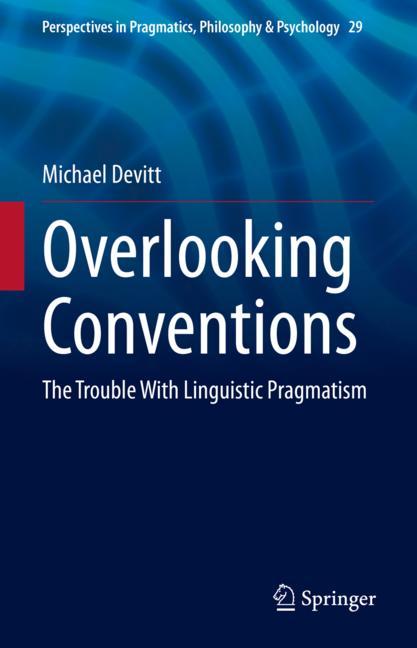
Overlooking Conventions
☆☆☆☆☆
(0 reviews)
Lowest price (incl. delivery)
7 435,00 JPY
Typical price7 435,00 PLN
Lowest (90 days)7 435,00 PLN
Offers2
Last updatedvor 1 Woche
| Verkäufer | Product price | Delivery | Gesamt | Verfügbarkeit | Updated | |
|---|---|---|---|---|---|---|
| SP SpringerNatureLink Shop INT | 7 435,00 JPY | free | 7 435,00 JPY | Verfügbar | vor 6 Tagen | View offer |
| SP Springer Nature Author | 7 435,00 JPY | 25,00 JPY | 7 460,00 JPY | Verfügbar | vor 1 Woche | View offer |
Preise und Verfügbarkeit können sich ändern. Zuletzt aktualisiert: 08.08.2026 23:16.
EAN
9783030706531
Springer Nature
0,0
☆☆☆☆☆
0 reviews
5★
0%
4★
0%
3★
0%
2★
0%
1★
0%
Product reviews
No reviews yet — be the first!
This book criticizes the methodology of the recent semantics-pragmatics debate in the theory of language and proposes an alternative. It applies this methodology to argue for a traditional view against a group of “contextualists” and “pragmatists”, including Sperber and Wilson, Bach, Carston, Recanati, Neale, and many others. The author disagrees with these theorists who hold that the meaning of the sentence in an utterance never, or hardly ever, yields its literal truth-conditional content, even after disambiguation and reference fixing; it needs to be pragmatically supplemented in context. The standard methodology of this debate is to consult intuitions. The book argues that theories should be tested against linguistic usage. Theoretical distinctions, however intuitive, need to be scientifically motivated. Also we should not be guided by Grice’s “Modified Occam’s Razor”, Ruhl’s “Monosemantic Bias”, or other such strategies for “meaning denialism”. From this novel perspective, the striking examples of context relativity that motivate contextualists and pragmatists typically exemplify semantic rather than pragmatic properties. In particular, polysemous phenomena should typically be treated as semantic ambiguity. The author argues that conventions have been overlooked, that there’s no extensive “semantic underdetermination” and that the new theoretical framework of “truth-conditional pragmatics” is a mistake.
Similar products
 50 Years of Philosophy and Medicine
from $107.30
50 Years of Philosophy and Medicine
from $107.30
 Understanding Cybersecurity Law and Digital Privacy
from $122.63
Understanding Cybersecurity Law and Digital Privacy
from $122.63
 Decisions in International Trade and Logistics
from $122.63
Decisions in International Trade and Logistics
from $122.63
 Advances in Economic Measurement
from $122.63
Advances in Economic Measurement
from $122.63
 Nanomaterials
from $137.96
Nanomaterials
from $137.96
 Sustainable Scaffolds-based Strategies in Tissue Engineering and Regenerative Medicine
from $162.87
Sustainable Scaffolds-based Strategies in Tissue Engineering and Regenerative Medicine
from $162.87
 Narratives in Educational Research
from $162.87
Narratives in Educational Research
from $162.87
 Environmental Biology of the Young Chinese Sturgeon
from $210.78
Environmental Biology of the Young Chinese Sturgeon
from $210.78