
Optimal Control
☆☆☆☆☆
(0 reviews)
Lowest price (incl. delivery)
8 608,00 JPY
Typical price4 323,17 PLN
Lowest (90 days)64,19 PLN
Offers3
Last updatedvor 1 Woche
| Verkäufer | Product price | Delivery | Gesamt | Verfügbarkeit | Updated | |
|---|---|---|---|---|---|---|
| SP SpringerNatureLink Shop INT | 8 579,00 JPY | 29,00 JPY | 8 608,00 JPY | Verfügbar | vor 3 Tagen | View offer |
| SP Springer Nature Author | 8 579,00 JPY | 29,00 JPY | 8 608,00 JPY | Verfügbar | vor 1 Woche | View offer |
| SP SpringerNatureLink Shop INT | 70,50 EUR | 25,00 EUR | 95,50 EUR | Verfügbar | vor 4 Tagen | View offer |
Preise und Verfügbarkeit können sich ändern. Zuletzt aktualisiert: 08.08.2026 23:17.
EAN
9783030910297
Springer Nature
0,0
☆☆☆☆☆
0 reviews
5★
0%
4★
0%
3★
0%
2★
0%
1★
0%
Product reviews
No reviews yet — be the first!
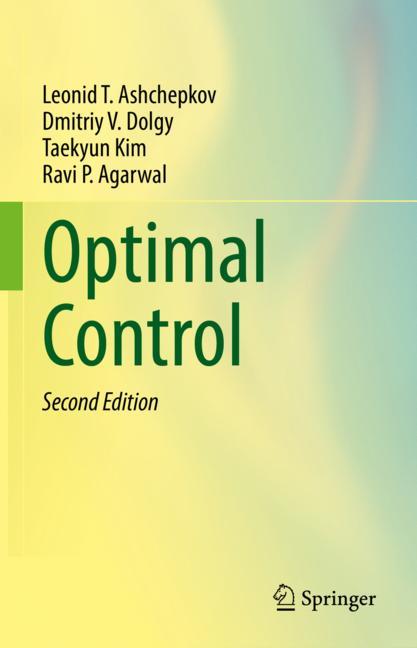
This textbook, now in its second edition, results from lectures, practical problems, and workshops on Optimal Control, given by the authors at Irkutsk State University, Far Eastern Federal University (both in Vladivostok, Russia), and Kwangwoon University (Seoul, South Korea). In this work, the authors cover the theory of linear and nonlinear systems, touching on the basic problem of establishing the necessary and sufficient conditions of optimal processes. Readers will find two new chapters, with results of potential interest to researchers with a focus on the theory of optimal control, as well as to those interested in applications in Engineering and related sciences. In addition, several improvements have been made through the text. This book is structured in three parts. Part I starts with a gentle introduction to the basic concepts in Optimal Control. In Part II, the theory of linear control systems is constructed on thebasis of the separation theorem and the concept of a reachability set. The authors prove the closure of reachability set in the class of piecewise continuous controls and touch on the problems of controllability, observability, identification, performance, and terminal control. Part III, in its turn, is devoted to nonlinear control systems. Using the method of variations and the Lagrange multipliers rule of nonlinear problems, the authors prove the Pontryagin maximum principle for problems with mobile ends of trajectories. Problem sets at the end of chapters and a list of additional tasks, provided in the appendix, are offered for students seeking to master the subject. The exercises have been chosen not only as a way to assimilate the theory but also as to induct the application of such knowledge in more advanced problems.
Similar products
 50 Years of Philosophy and Medicine
from $107.30
50 Years of Philosophy and Medicine
from $107.30
 Understanding Cybersecurity Law and Digital Privacy
from $122.63
Understanding Cybersecurity Law and Digital Privacy
from $122.63
 Decisions in International Trade and Logistics
from $122.63
Decisions in International Trade and Logistics
from $122.63
 Advances in Economic Measurement
from $122.63
Advances in Economic Measurement
from $122.63
 Nanomaterials
from $137.96
Nanomaterials
from $137.96
 Sustainable Scaffolds-based Strategies in Tissue Engineering and Regenerative Medicine
from $162.87
Sustainable Scaffolds-based Strategies in Tissue Engineering and Regenerative Medicine
from $162.87
 Narratives in Educational Research
from $162.87
Narratives in Educational Research
from $162.87
 Environmental Biology of the Young Chinese Sturgeon
from $210.78
Environmental Biology of the Young Chinese Sturgeon
from $210.78