
On Coexistence Patterns
☆☆☆☆☆
(0 reviews)
Lowest price (incl. delivery)
189,49 EUR
Typical price4 247,29 PLN
Lowest (90 days)160,49 PLN
Offers7
Last updatedvor 1 Woche
Price history (90 days)
Full history
2026-08-08
2026-08-15
| Aktualisiert am | Preis |
|---|---|
| 2026-08-08 | 160,49 |
| 2026-08-15 | 179,99 |
| Verkäufer | Product price | Delivery | Gesamt | Verfügbarkeit | Updated | |
|---|---|---|---|---|---|---|
| SP SpringerNatureLink Shop INT | 160,49 EUR | 29,00 EUR | 189,49 EUR | Verfügbar | vor 3 Tagen | View offer |
| SP SpringerNatureLink Shop INT | 28 599,00 JPY | 29,00 JPY | 28 628,00 JPY | Verfügbar | vor 3 Tagen | View offer |
| SP Springer Nature Author | 28 599,00 JPY | 25,00 JPY | 28 624,00 JPY | Verfügbar | vor 1 Woche | View offer |
| SP SpringerNatureLink Shop INT | 199,99 USD | 15,00 USD | 214,99 USD | Verfügbar | vor 3 Tagen | View offer |
| SP SpringerNatureLink Shop INT | 219,99 USD | free | 219,99 USD | Verfügbar | vor 3 Tagen | View offer |
| SP SpringerNatureLink Shop INT | 219,99 USD | 29,00 USD | 248,99 USD | Verfügbar | vor 3 Tagen | View offer |
| SP SpringerNatureLink Shop INT | 236,00 EUR | 15,00 EUR | 251,00 EUR | Verfügbar | vor 3 Tagen | View offer |
Preise und Verfügbarkeit können sich ändern. Zuletzt aktualisiert: 08.08.2026 23:36.
0,0
☆☆☆☆☆
0 reviews
5★
0%
4★
0%
3★
0%
2★
0%
1★
0%
Product reviews
No reviews yet — be the first!
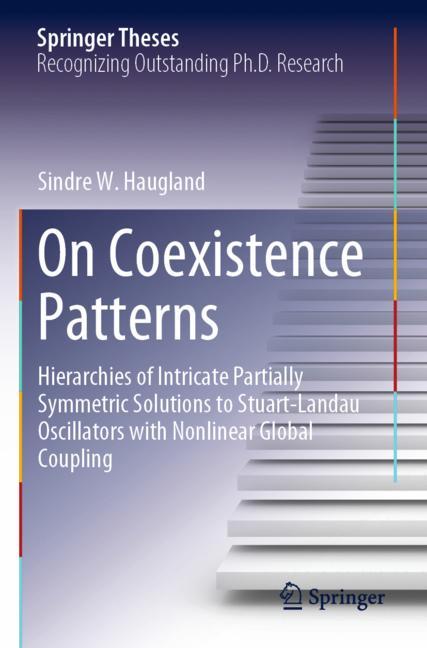
This book is about coexistence patterns in ensembles of globally coupled nonlinear oscillators. Coexistence patterns in this respect are states of a dynamical system in which the dynamics in some parts of the system differ significantly from those in other parts, even though there is no underlying structural difference between the different parts. In other words, these asymmetric patterns emerge in a self-organized manner. As our main model, we use ensembles of various numbers of Stuart-Landau oscillators, all with the same natural frequency and all coupled equally strongly to each other. Employing computer simulations, bifurcation analysis and symmetry considerations, we uncover the mechanism behind a wide range of complex patterns found in these ensembles. Our starting point is the creation of so-called chimeras, which are subsequently treated within a new and broader context of related states.
Similar products
 50 Years of Philosophy and Medicine
from $107.30
50 Years of Philosophy and Medicine
from $107.30
 Understanding Cybersecurity Law and Digital Privacy
from $122.63
Understanding Cybersecurity Law and Digital Privacy
from $122.63
 Decisions in International Trade and Logistics
from $122.63
Decisions in International Trade and Logistics
from $122.63
 Advances in Economic Measurement
from $122.63
Advances in Economic Measurement
from $122.63
 Nanomaterials
from $137.96
Nanomaterials
from $137.96
 Sustainable Scaffolds-based Strategies in Tissue Engineering and Regenerative Medicine
from $162.87
Sustainable Scaffolds-based Strategies in Tissue Engineering and Regenerative Medicine
from $162.87
 Narratives in Educational Research
from $162.87
Narratives in Educational Research
from $162.87
 Environmental Biology of the Young Chinese Sturgeon
from $210.78
Environmental Biology of the Young Chinese Sturgeon
from $210.78