
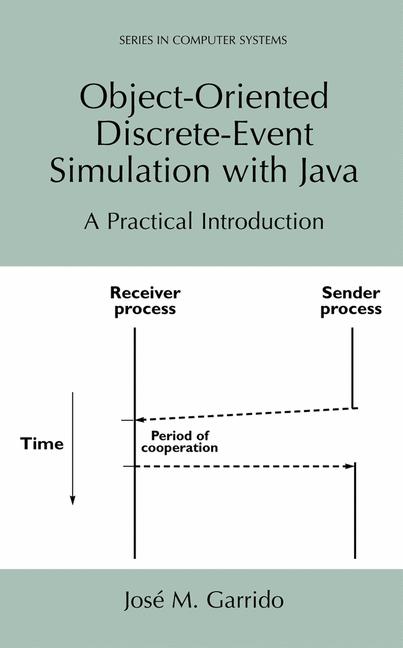
Object-Oriented Discrete-Event Simulation with Java
☆☆☆☆☆
(0 reviews)
Lowest price (incl. delivery)
21 468,00 JPY
Typical price3 712,91 PLN
Lowest (90 days)155,99 PLN
Offers1
Last updatedvor 1 Tag
| Verkäufer | Product price | Delivery | Gesamt | Verfügbarkeit | Updated | |
|---|---|---|---|---|---|---|
| SP Springer Nature Author | 21 449,00 JPY | 19,00 JPY | 21 468,00 JPY | Verfügbar | vor 1 Tag | View offer |
Preise und Verfügbarkeit können sich ändern. Zuletzt aktualisiert: 08.08.2026 23:34.
0,0
☆☆☆☆☆
0 reviews
5★
0%
4★
0%
3★
0%
2★
0%
1★
0%
Product reviews
No reviews yet — be the first!
Researches and developers of simulation models state that the Java program ming language presents a unique and significant opportunity for important changes in the way we develop simulation models today. The most important characteristics of the Java language that are advantageous for simulation are its multi-threading capabilities, its facilities for executing programs across the Web, and its graphics facilities. It is feasible to develop compatible and reusable simulation components that will facilitate the construction of newer and more complex models. This is possible with Java development environments. Another important trend that begun very recently is web-based simulation, i.e., and the execution of simulation models using Internet browser software. This book introduces the application of the Java programming language in discrete-event simulation. In addition, the fundamental concepts and prac tical simulation techniques for modeling different types of systems to study their general behavior and their performance are introduced. The approaches applied are the process interaction approach to discrete-event simulation and object-oriented modeling. Java is used as the implementation language and UML as the modeling language. The first offers several advantages compared to C++, the most important being: thread handling, graphical user interfaces (QUI) and Web computing. The second language, UML (Unified Modeling Language) is the standard notation used today for modeling systems as a collection of classes, class relationships, objects, and object behavior.
Similar products
 Gamma Knife Neurosurgery in the Management of Intracranial Disorders
from $210.78
Gamma Knife Neurosurgery in the Management of Intracranial Disorders
from $210.78
 SDGs in Construction Economics and Organization
from $210.78
SDGs in Construction Economics and Organization
from $210.78
 Emerging Therapies in Neurorehabilitation III
from $210.78
Emerging Therapies in Neurorehabilitation III
from $210.78
 Ground Improvement Techniques
from $220.36
Ground Improvement Techniques
from $220.36
 Anomaly Detection in Video Surveillance
from $220.36
Anomaly Detection in Video Surveillance
from $220.36
 Mechanism and Machine Science
from $287.42
Mechanism and Machine Science
from $287.42
 Protein-Protein Interactions as New Drug Targets
from $287.42
Protein-Protein Interactions as New Drug Targets
from $287.42
 Proceedings of the 7th International Conference of Transportation Research Group of India (CTRG 2023
from $287.42
Proceedings of the 7th International Conference of Transportation Research Group of India (CTRG 2023
from $287.42