
Modular Units
☆☆☆☆☆
(0 reviews)
Lowest price (incl. delivery)
28 628,00 JPY
Typical price4 173,43 PLN
Lowest (90 days)179,99 PLN
Offers6
Last updatedvor 6 Tagen
Price history (90 days)
Full history
2026-08-08
2026-08-15
| Aktualisiert am | Preis |
|---|---|
| 2026-08-08 | 179,99 |
| 2026-08-15 | 207,99 |
| Verkäufer | Product price | Delivery | Gesamt | Verfügbarkeit | Updated | |
|---|---|---|---|---|---|---|
| SP SpringerNatureLink Shop INT | 28 599,00 JPY | 29,00 JPY | 28 628,00 JPY | Verfügbar | vor 2 Stunden | View offer |
| SP Springer Nature Author | 28 599,00 JPY | free | 28 599,00 JPY | Verfügbar | vor 6 Tagen | View offer |
| SP SpringerNatureLink Shop INT | 199,99 USD | 15,00 USD | 214,99 USD | Verfügbar | vor 3 Stunden | View offer |
| SP SpringerNatureLink Shop INT | 219,99 USD | free | 219,99 USD | Verfügbar | vor 3 Stunden | View offer |
| SP SpringerNatureLink Shop INT | 219,99 USD | 25,00 USD | 244,99 USD | Verfügbar | vor 3 Stunden | View offer |
| SP SpringerNatureLink Shop INT | 236,00 EUR | free | 236,00 EUR | Verfügbar | vor 3 Stunden | View offer |
Preise und Verfügbarkeit können sich ändern. Zuletzt aktualisiert: 08.08.2026 23:38.
0,0
☆☆☆☆☆
0 reviews
5★
0%
4★
0%
3★
0%
2★
0%
1★
0%
Product reviews
No reviews yet — be the first!
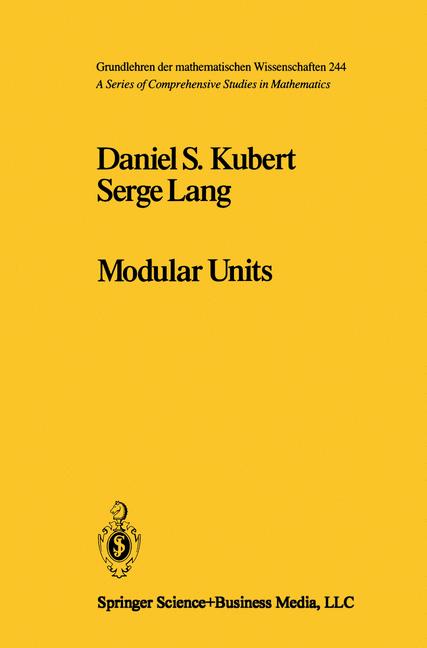
In the present book, we have put together the basic theory of the units and cuspidal divisor class group in the modular function fields, developed over the past few years. Let i) be the upper half plane, and N a positive integer. Let r(N) be the subgroup of SL (Z) consisting of those matrices == 1 mod N. Then r(N)\i) 2 is complex analytic isomorphic to an affine curve YeN), whose compactifi cation is called the modular curve X(N). The affine ring of regular functions on yeN) over C is the integral closure of C[j] in the function field of X(N) over C. Here j is the classical modular function. However, for arithmetic applications, one considers the curve as defined over the cyclotomic field Q(JlN) of N-th roots of unity, and one takes the integral closure either of Q[j] or Z[j], depending on how much arithmetic one wants to throw in. The units in these rings consist of those modular functions which have no zeros or poles in the upper half plane. The points of X(N) which lie at infinity,that is which do not correspond to points on the above affine set, are called the cusps, because of the way they look in a fundamental domain in the upper half plane. They generate a subgroup of the divisor class group, which turns out to be finite, and is called the cuspidal divisor class group.
Similar products
 50 Years of Philosophy and Medicine
from $107.30
50 Years of Philosophy and Medicine
from $107.30
 Understanding Cybersecurity Law and Digital Privacy
from $122.63
Understanding Cybersecurity Law and Digital Privacy
from $122.63
 Decisions in International Trade and Logistics
from $122.63
Decisions in International Trade and Logistics
from $122.63
 Advances in Economic Measurement
from $122.63
Advances in Economic Measurement
from $122.63
 Nanomaterials
from $137.96
Nanomaterials
from $137.96
 Sustainable Scaffolds-based Strategies in Tissue Engineering and Regenerative Medicine
from $162.87
Sustainable Scaffolds-based Strategies in Tissue Engineering and Regenerative Medicine
from $162.87
 Narratives in Educational Research
from $162.87
Narratives in Educational Research
from $162.87
 Environmental Biology of the Young Chinese Sturgeon
from $210.78
Environmental Biology of the Young Chinese Sturgeon
from $210.78