
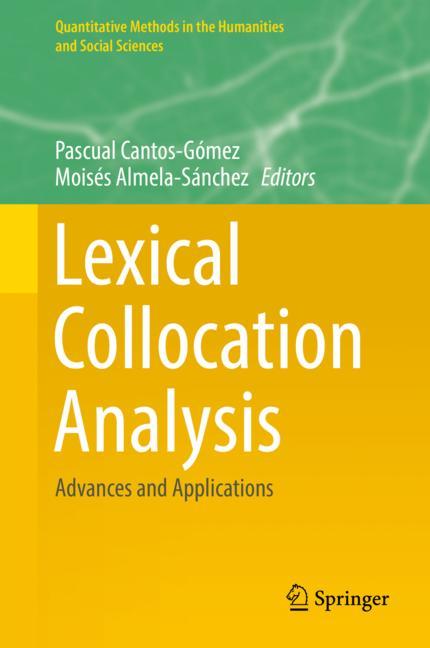
Lexical Collocation Analysis
☆☆☆☆☆
(0 reviews)
Lowest price (incl. delivery)
122,50 GBP
Typical price3 129,87 PLN
Lowest (90 days)117,69 PLN
Offers2
Last updatedvor 2 Tagen
| Verkäufer | Product price | Delivery | Gesamt | Verfügbarkeit | Updated | |
|---|---|---|---|---|---|---|
| SP SpringerNatureLink Shop INT | 103,50 GBP | 19,00 GBP | 122,50 GBP | Verfügbar | vor 3 Tagen | View offer |
| SP Springer Nature Author | 21 449,00 JPY | free | 21 449,00 JPY | Verfügbar | vor 2 Tagen | View offer |
Preise und Verfügbarkeit können sich ändern. Zuletzt aktualisiert: 08.08.2026 23:28.
0,0
☆☆☆☆☆
0 reviews
5★
0%
4★
0%
3★
0%
2★
0%
1★
0%
Product reviews
No reviews yet — be the first!
This book re-examines the notion of word associations, more precisely collocations. It attempts to come to a potentially more generally applicable definition of collocation and how to best extract, identify and measure collocations. The book highlights the role played by (i) automatic linguistic annotation (part-of-speech tagging, syntactic parsing, etc.), (ii) using semantic criteria to facilitate the identification of collocations, (iii) multi-word structured, instead of the widespread assumption of bipartite collocational structures, for capturing the intricacies of the phenomenon of syntagmatic attraction, (iv) considering collocation and valency as near neighbours in the lexis-grammar continuum and (v) the mathematical properties of statistical association measures in the automatic extraction of collocations from corpora. This book is an ideal guide to the use of statistics in collocation analysis and lexicography, as well as a practical text to the development of skills inthe application of computational lexicography. Lexical Collocation Analysis: Advances and Applications begins with a proposal for integrating both collocational and valency phenomena within the overarching theoretical framework of construction grammar. Next the book makes the case for integrating advances in syntactic parsing and in collocational analysis. Chapter 3 offers an innovative look at complementing corpus data and dictionaries in the identification of specific types of collocations consisting of restricted predicate-argument combinations. This strategy complements corpus collocational data with network analysis techniques applied to dictionary entries. Chapter 4 explains the potential of collocational graphs and networks both as a visualization tool and as an analytical technique. Chapter 5 introduces MERGE (Multi-word Expressions from the Recursive Grouping of Elements), a data-driven approach to the identification and extraction of multi-word expressions from corpora. Finally the book concludes with an analysis and evaluation of factors influencing the performance of collocation extraction methods in parsed corpora.
Similar products
 Patient Safety Coaching
from $91.97
Patient Safety Coaching
from $91.97
 Ethnography and Diversity
from $69.30
Ethnography and Diversity
from $69.30
 Smart Villages
from $91.97
Smart Villages
from $91.97
 Nuclear Non-Proliferation in International Law - Volume VI
from $91.97
Nuclear Non-Proliferation in International Law - Volume VI
from $91.97
 The Price of Freedom
from $91.97
The Price of Freedom
from $91.97
 Eco-Social Policy in the OECD and the World Bank
from $91.97
Eco-Social Policy in the OECD and the World Bank
from $91.97
 Special Topics in Policing
from $122.58
Special Topics in Policing
from $122.58
 Music from the Heart
from $91.97
Music from the Heart
from $91.97