
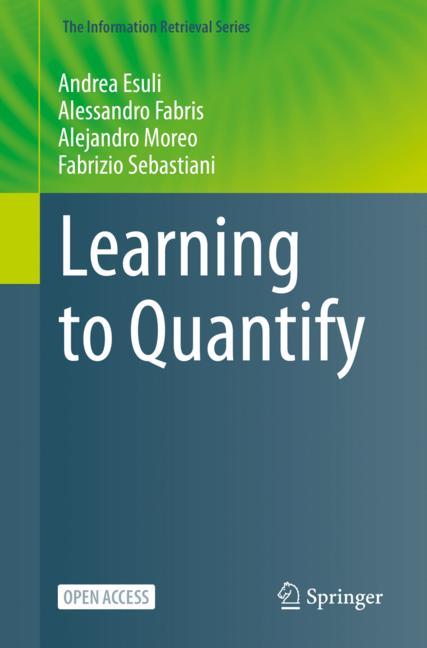
Learning to Quantify
☆☆☆☆☆
(0 reviews)
Lowest price (incl. delivery)
5 734,00 JPY
Typical price399,33 PLN
Lowest (90 days)39,99 PLN
Offers2
Last updatedvor 23 Stunden
| Verkäufer | Product price | Delivery | Gesamt | Verfügbarkeit | Updated | |
|---|---|---|---|---|---|---|
| SP Springer Nature Author | 5 719,00 JPY | 15,00 JPY | 5 734,00 JPY | Verfügbar | vor 23 Stunden | View offer |
| SP SpringerNatureLink Shop INT | 49,99 USD | 19,00 USD | 68,99 USD | Verfügbar | vor 1 Tag | View offer |
Preise und Verfügbarkeit können sich ändern. Zuletzt aktualisiert: 08.08.2026 23:08.
0,0
☆☆☆☆☆
0 reviews
5★
0%
4★
0%
3★
0%
2★
0%
1★
0%
Product reviews
No reviews yet — be the first!
This open access book provides an introduction and an overview of learning to quantify (a.k.a. “quantification”), i.e. the task of training estimators of class proportions in unlabeled data by means of supervised learning. In data science, learning to quantify is a task of its own related to classification yet different from it, since estimating class proportions by simply classifying all data and counting the labels assigned by the classifier is known to often return inaccurate (“biased”) class proportion estimates. The book introduces learning to quantify by looking at the supervised learning methods that can be used to perform it, at the evaluation measures and evaluation protocols that should be used for evaluating the quality of the returned predictions, at the numerous fields of human activity in which the use of quantification techniques may provide improved results with respect to the naive use of classification techniques, and at advanced topics in quantification research. The book is suitable to researchers, data scientists, or PhD students, who want to come up to speed with the state of the art in learning to quantify, but also to researchers wishing to apply data science technologies to fields of human activity (e.g., the social sciences, political science, epidemiology, market research) which focus on aggregate (“macro”) data rather than on individual (“micro”) data.
Similar products
 Patient Safety Coaching
from $91.97
Patient Safety Coaching
from $91.97
 Ethnography and Diversity
from $69.30
Ethnography and Diversity
from $69.30
 Smart Villages
from $91.97
Smart Villages
from $91.97
 Nuclear Non-Proliferation in International Law - Volume VI
from $91.97
Nuclear Non-Proliferation in International Law - Volume VI
from $91.97
 The Price of Freedom
from $91.97
The Price of Freedom
from $91.97
 Eco-Social Policy in the OECD and the World Bank
from $91.97
Eco-Social Policy in the OECD and the World Bank
from $91.97
 Special Topics in Policing
from $122.58
Special Topics in Policing
from $122.58
 Music from the Heart
from $91.97
Music from the Heart
from $91.97