
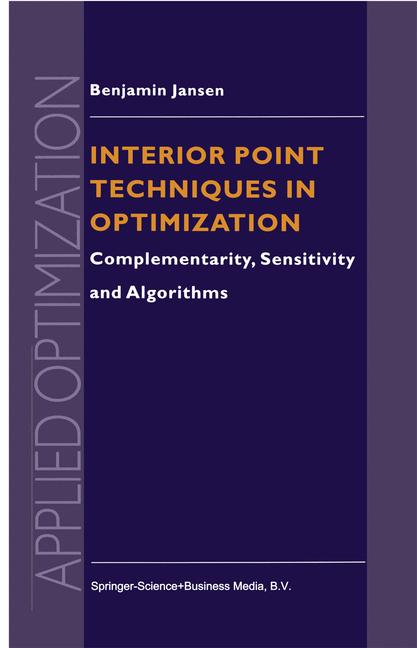
Interior Point Techniques in Optimization
☆☆☆☆☆
(0 reviews)
Lowest price (incl. delivery)
21 468,00 JPY
Typical price3 268,03 PLN
Lowest (90 days)155,99 PLN
Offers6
Last updatedvor 1 Woche
Price history (90 days)
Full history
2026-08-08
2026-08-15
| Aktualisiert am | Preis |
|---|---|
| 2026-08-08 | 155,99 |
| 2026-08-15 | 155,99 |
| Verkäufer | Product price | Delivery | Gesamt | Verfügbarkeit | Updated | |
|---|---|---|---|---|---|---|
| SP SpringerNatureLink Shop INT | 21 449,00 JPY | 19,00 JPY | 21 468,00 JPY | Verfügbar | vor 2 Tagen | View offer |
| SP Springer Nature Author | 21 449,00 JPY | 19,00 JPY | 21 468,00 JPY | Verfügbar | vor 1 Woche | View offer |
| SP SpringerNatureLink Shop INT | 149,99 USD | 15,00 USD | 164,99 USD | Verfügbar | vor 2 Tagen | View offer |
| SP SpringerNatureLink Shop INT | 169,99 USD | 25,00 USD | 194,99 USD | Verfügbar | vor 2 Tagen | View offer |
| SP SpringerNatureLink Shop INT | 169,99 USD | 19,00 USD | 188,99 USD | Verfügbar | vor 2 Tagen | View offer |
| SP SpringerNatureLink Shop INT | 177,00 EUR | 29,00 EUR | 206,00 EUR | Verfügbar | vor 2 Tagen | View offer |
Preise und Verfügbarkeit können sich ändern. Zuletzt aktualisiert: 08.08.2026 23:34.
0,0
☆☆☆☆☆
0 reviews
5★
0%
4★
0%
3★
0%
2★
0%
1★
0%
Product reviews
No reviews yet — be the first!
Operations research and mathematical programming would not be as advanced today without the many advances in interior point methods during the last decade. These methods can now solve very efficiently and robustly large scale linear, nonlinear and combinatorial optimization problems that arise in various practical applications. The main ideas underlying interior point methods have influenced virtually all areas of mathematical programming including: analyzing and solving linear and nonlinear programming problems, sensitivity analysis, complexity analysis, the analysis of Newton's method, decomposition methods, polynomial approximation for combinatorial problems etc. This book covers the implications of interior techniques for the entire field of mathematical programming, bringing together many results in a uniform and coherent way. For the topics mentioned above the book provides theoretical as well as computational results, explains the intuition behind the main ideas, gives examples as well as proofs, and contains an extensive up-to-date bibliography. Audience: The book is intended for students, researchers and practitioners with a background in operations research, mathematics, mathematical programming, or statistics.
Similar products
 50 Years of Philosophy and Medicine
from $107.30
50 Years of Philosophy and Medicine
from $107.30
 Understanding Cybersecurity Law and Digital Privacy
from $122.63
Understanding Cybersecurity Law and Digital Privacy
from $122.63
 Decisions in International Trade and Logistics
from $122.63
Decisions in International Trade and Logistics
from $122.63
 Advances in Economic Measurement
from $122.63
Advances in Economic Measurement
from $122.63
 Nanomaterials
from $137.96
Nanomaterials
from $137.96
 Sustainable Scaffolds-based Strategies in Tissue Engineering and Regenerative Medicine
from $162.87
Sustainable Scaffolds-based Strategies in Tissue Engineering and Regenerative Medicine
from $162.87
 Narratives in Educational Research
from $162.87
Narratives in Educational Research
from $162.87
 Environmental Biology of the Young Chinese Sturgeon
from $210.78
Environmental Biology of the Young Chinese Sturgeon
from $210.78