
Group Processes
☆☆☆☆☆
(0 reviews)
Lowest price (incl. delivery)
17 174,00 JPY
Typical price1 029,40 PLN
Lowest (90 days)87,50 PLN
Offers2
Last updatedvor 17 Stunden
| Verkäufer | Product price | Delivery | Gesamt | Verfügbarkeit | Updated | |
|---|---|---|---|---|---|---|
| SP Springer Nature Author | 17 159,00 JPY | 15,00 JPY | 17 174,00 JPY | Verfügbar | vor 16 Stunden | View offer |
| SP SpringerNatureLink Shop INT | 109,99 GBP | 19,00 GBP | 128,99 GBP | Verfügbar | vor 1 Tag | View offer |
Preise und Verfügbarkeit können sich ändern. Zuletzt aktualisiert: 08.08.2026 22:18.
0,0
☆☆☆☆☆
0 reviews
5★
0%
4★
0%
3★
0%
2★
0%
1★
0%
Product reviews
No reviews yet — be the first!
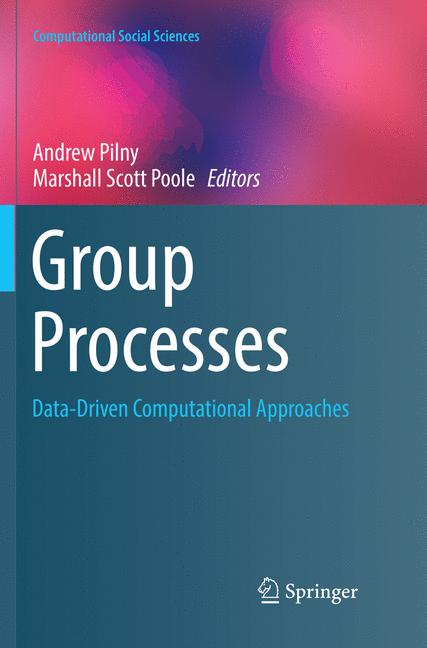
This volume introduces a series of different data-driven computational methods for analyzing group processes through didactic and tutorial-based examples. Group processes are of central importance to many sectors of society, including government, the military, health care, and corporations. Computational methods are better suited to handle (potentially huge) group process data than traditional methodologies because of their more flexible assumptions and capability to handle real-time trace data. Indeed, the use of methods under the name of computational social science have exploded over the years. However, attention has been focused on original research rather than pedagogy, leaving those interested in obtaining computational skills lacking a much needed resource. Although the methods here can be applied to wider areas of social science, they are specifically tailored to group process research. A number of data-driven methodsadapted to group process research are demonstrated in this current volume. These include text mining, relational event modeling, social simulation, machine learning, social sequence analysis, and response surface analysis. In order to take advantage of these new opportunities, this book provides clear examples (e.g., providing code) of group processes in various contexts, setting guidelines and best practices for future work to build upon. This volume will be of great benefit to those willing to learn computational methods. These include academics like graduate students and faculty, multidisciplinary professionals and researchers working on organization and management science, and consultants for various types of organizations and groups.
Similar products
 Patient Safety Coaching
from $91.97
Patient Safety Coaching
from $91.97
 Ethnography and Diversity
from $69.30
Ethnography and Diversity
from $69.30
 Smart Villages
from $91.97
Smart Villages
from $91.97
 Nuclear Non-Proliferation in International Law - Volume VI
from $91.97
Nuclear Non-Proliferation in International Law - Volume VI
from $91.97
 The Price of Freedom
from $91.97
The Price of Freedom
from $91.97
 Eco-Social Policy in the OECD and the World Bank
from $91.97
Eco-Social Policy in the OECD and the World Bank
from $91.97
 Special Topics in Policing
from $122.58
Special Topics in Policing
from $122.58
 Music from the Heart
from $91.97
Music from the Heart
from $91.97