
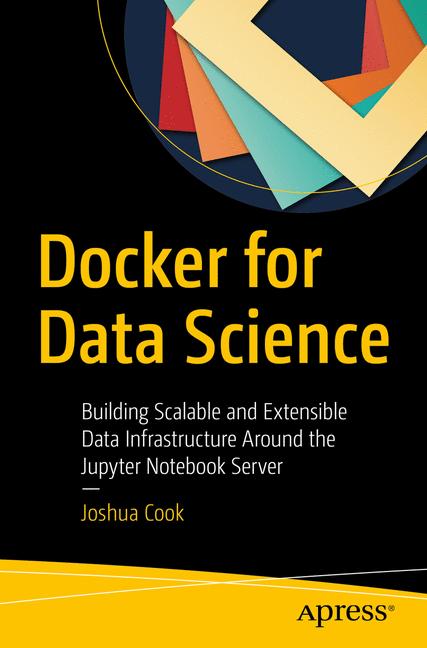
Docker for Data Science
☆☆☆☆☆
(0 reviews)
Lowest price (incl. delivery)
88,99 USD
Typical price53,49 PLN
Lowest (90 days)43,99 PLN
Offers6
Last updatedvor 1 Woche
Price history (90 days)
Full history
2026-08-08
2026-08-15
| Aktualisiert am | Preis |
|---|---|
| 2026-08-08 | 44,99 |
| 2026-08-14 | 43,99 |
| 2026-08-15 | 54,99 |
| Verkäufer | Product price | Delivery | Gesamt | Verfügbarkeit | Updated | |
|---|---|---|---|---|---|---|
| SP SpringerNatureLink Shop INT | 59,99 USD | 29,00 USD | 88,99 USD | Verfügbar | vor 1 Tag | View offer |
| SP SpringerNatureLink Shop INT | 59,99 USD | 25,00 USD | 84,99 USD | Verfügbar | vor 1 Tag | View offer |
| SP SpringerNatureLink Shop INT | 59,99 USD | 29,00 USD | 88,99 USD | Verfügbar | vor 1 Tag | View offer |
| SP SpringerNatureLink Shop INT | 59,99 USD | 15,00 USD | 74,99 USD | Verfügbar | vor 1 Tag | View offer |
| SP Springer Nature Author | 59,99 USD | free | 59,99 USD | Verfügbar | vor 1 Woche | View offer |
| SP SpringerNatureLink Shop INT | 64,19 EUR | 19,00 EUR | 83,19 EUR | Verfügbar | vor 1 Tag | View offer |
Preise und Verfügbarkeit können sich ändern. Zuletzt aktualisiert: 08.08.2026 10:41.
0,0
☆☆☆☆☆
0 reviews
5★
0%
4★
0%
3★
0%
2★
0%
1★
0%
Product reviews
No reviews yet — be the first!
Learn Docker "infrastructure as code" technology to define a system for performing standard but non-trivial data tasks on medium- to large-scale data sets, using Jupyter as the master controller. It is not uncommon for a real-world data set to fail to be easily managed. The set may not fit well into access memory or may require prohibitively long processing. These are significant challenges to skilled software engineers and they can render the standard Jupyter system unusable. As a solution to this problem, Docker for Data Science proposes using Docker. You will learn how to use existing pre-compiled public images created by the major open-source technologies—Python, Jupyter, Postgres—as well as using the Dockerfile to extend these images to suit your specific purposes. The Docker-Compose technology is examined and you will learn how it can be used to build a linked system with Python churning data behind the scenesand Jupyter managing these background tasks. Best practices in using existing images are explored as well as developing your own images to deploy state-of-the-art machine learning and optimization algorithms. What You'll Learn Master interactive development using the Jupyter platform Run and build Docker containers from scratch and from publicly available open-source images Write infrastructure as code using the docker-compose tool and its docker-compose.yml file type Deploy a multi-service data science application across a cloud-based system Who This Book Is For Data scientists, machine learning engineers, artificial intelligence researchers, Kagglers, and software developers
Similar products
 Gamma Knife Neurosurgery in the Management of Intracranial Disorders
from $210.78
Gamma Knife Neurosurgery in the Management of Intracranial Disorders
from $210.78
 SDGs in Construction Economics and Organization
from $210.78
SDGs in Construction Economics and Organization
from $210.78
 Emerging Therapies in Neurorehabilitation III
from $210.78
Emerging Therapies in Neurorehabilitation III
from $210.78
 Ground Improvement Techniques
from $220.36
Ground Improvement Techniques
from $220.36
 Anomaly Detection in Video Surveillance
from $220.36
Anomaly Detection in Video Surveillance
from $220.36
 Mechanism and Machine Science
from $287.42
Mechanism and Machine Science
from $287.42
 Protein-Protein Interactions as New Drug Targets
from $287.42
Protein-Protein Interactions as New Drug Targets
from $287.42
 Proceedings of the 7th International Conference of Transportation Research Group of India (CTRG 2023
from $287.42
Proceedings of the 7th International Conference of Transportation Research Group of India (CTRG 2023
from $287.42