
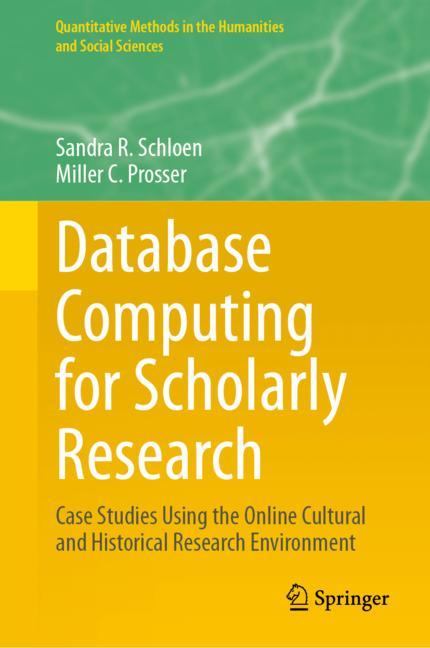
Database Computing for Scholarly Research
☆☆☆☆☆
(0 reviews)
Lowest price (incl. delivery)
20 038,00 JPY
Typical price1 369,31 PLN
Lowest (90 days)109,99 PLN
Offers6
Last updatedvor 1 Woche
Price history (90 days)
Full history
2026-08-08
2026-08-15
| Aktualisiert am | Preis |
|---|---|
| 2026-08-08 | 109,99 |
| 2026-08-15 | 119,99 |
| Verkäufer | Product price | Delivery | Gesamt | Verfügbarkeit | Updated | |
|---|---|---|---|---|---|---|
| SP SpringerNatureLink Shop INT | 20 019,00 JPY | 19,00 JPY | 20 038,00 JPY | Verfügbar | vor 4 Tagen | View offer |
| SP Springer Nature Author | 20 019,00 JPY | free | 20 019,00 JPY | Verfügbar | vor 1 Woche | View offer |
| SP SpringerNatureLink Shop INT | 139,99 USD | free | 139,99 USD | Verfügbar | vor 4 Tagen | View offer |
| SP SpringerNatureLink Shop INT | 159,99 USD | free | 159,99 USD | Verfügbar | vor 4 Tagen | View offer |
| SP SpringerNatureLink Shop INT | 159,99 USD | 25,00 USD | 184,99 USD | Verfügbar | vor 4 Tagen | View offer |
| SP SpringerNatureLink Shop INT | 165,50 EUR | free | 165,50 EUR | Verfügbar | vor 4 Tagen | View offer |
Preise und Verfügbarkeit können sich ändern. Zuletzt aktualisiert: 08.08.2026 22:34.
0,0
☆☆☆☆☆
0 reviews
5★
0%
4★
0%
3★
0%
2★
0%
1★
0%
Product reviews
No reviews yet — be the first!
This book discusses in detail a series of examples drawn from scholarly projects that use the OCHRE database platform (Online Cultural and Historical Research Environment). These case studies illustrate the wide range of data that can be managed with this platform and the wide variety of problems solved by OCHRE’s item-based graph data model. The unique features and design principles of the OCHRE platform are explained and justified, helping readers to imagine how the system could be used for their own data. Data generated by studies in the humanities and social sciences is often semi-structured, fragmented, highly variable, and subject to many interpretations, making it difficult to represent adequately in a conventional database. The authors examine commonly used methods of data management in the humanities and offer a compelling argument for a different approach that takes advantage of powerful computational techniques for organizing scholarly information. This book is achallenge to scholars in the humanities and social sciences, asking them to expect more from technology as they pursue their research goals. Written jointly by a software engineer and a research scholar, each with many years of experience in applying database methods to diverse kinds of scholarly data, it shows how scholars can make the most of their existing data while going beyond the limitations of commonly used software tools to represent their objects of study in a more accurate, nuanced, and flexible way.
Similar products
 50 Years of Philosophy and Medicine
from $107.30
50 Years of Philosophy and Medicine
from $107.30
 Understanding Cybersecurity Law and Digital Privacy
from $122.63
Understanding Cybersecurity Law and Digital Privacy
from $122.63
 Decisions in International Trade and Logistics
from $122.63
Decisions in International Trade and Logistics
from $122.63
 Advances in Economic Measurement
from $122.63
Advances in Economic Measurement
from $122.63
 Nanomaterials
from $137.96
Nanomaterials
from $137.96
 Sustainable Scaffolds-based Strategies in Tissue Engineering and Regenerative Medicine
from $162.87
Sustainable Scaffolds-based Strategies in Tissue Engineering and Regenerative Medicine
from $162.87
 Narratives in Educational Research
from $162.87
Narratives in Educational Research
from $162.87
 Environmental Biology of the Young Chinese Sturgeon
from $210.78
Environmental Biology of the Young Chinese Sturgeon
from $210.78