
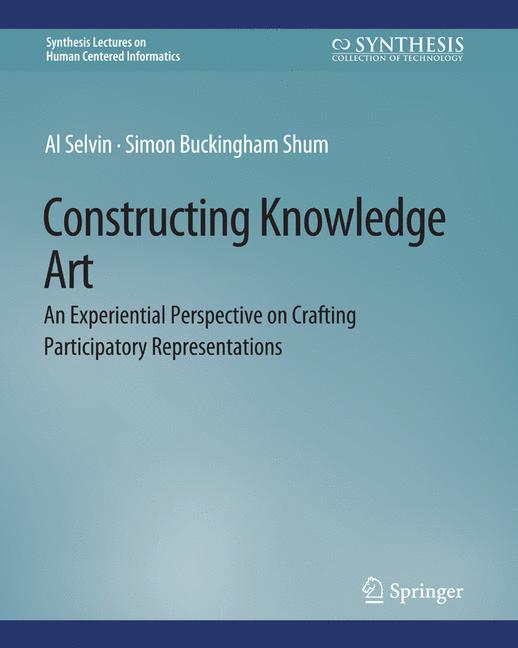
Constructing Knowledge Art
☆☆☆☆☆
(0 reviews)
Lowest price (incl. delivery)
37,44 EUR
Typical price42,24 PLN
Lowest (90 days)37,44 PLN
Offers3
Last updatedvor 1 Tag
| Verkäufer | Product price | Delivery | Gesamt | Verfügbarkeit | Updated | |
|---|---|---|---|---|---|---|
| SP SpringerNatureLink Shop INT | 37,44 EUR | free | 37,44 EUR | Verfügbar | vor 1 Tag | View offer |
| SP SpringerNatureLink Shop INT | 49,99 USD | free | 49,99 USD | Verfügbar | vor 1 Tag | View offer |
| SP Springer Nature Author | 49,99 USD | 25,00 USD | 74,99 USD | Verfügbar | vor 16 Stunden | View offer |
Preise und Verfügbarkeit können sich ändern. Zuletzt aktualisiert: 08.08.2026 09:14.
0,0
☆☆☆☆☆
0 reviews
5★
0%
4★
0%
3★
0%
2★
0%
1★
0%
Product reviews
No reviews yet — be the first!
This book is about how people (we refer to them as practitioners) can help guide participants in creating representations of issues or ideas, such as collaborative diagrams, especially in the context of Participatory Design (PD). At its best, such representations can reach a very high level of expressiveness and usefulness, an ideal we refer to as Knowledge Art. Achieving that level requires effective engagement, often aided by facilitators or other practitioners. Most PD research focuses on tools and methods, or on participant experience. The next source of advantage is to better illuminate the role of practitioners-the people working with participants, tools, and methods in service of a project’s larger goals. Just like participants, practitioners experience challenges, interactions, and setbacks, and come up with creative ways to address them while maintaining their stance of service to participants and stakeholders. Our research interest is in understanding what moves and choices practitioners make that either help or hinder participants’ engagement with representations. We present a theoretical framework that looks at these choices from the experiential perspectives of narrative, aesthetics, ethics, sensemaking and improvisation and apply it to five diverse case studies of actual practice. Table of Contents: Acknowledgments / Introduction / Participatory Design and Representational Practice / Dimensions of Knowledge Art / Case Studies / Discussion and Conclusions / Appendix: Knowledge Art Analytics / Bibliography / Author Biographies
Similar products
 Patient Safety Coaching
from $91.97
Patient Safety Coaching
from $91.97
 Ethnography and Diversity
from $69.30
Ethnography and Diversity
from $69.30
 Smart Villages
from $91.97
Smart Villages
from $91.97
 Nuclear Non-Proliferation in International Law - Volume VI
from $91.97
Nuclear Non-Proliferation in International Law - Volume VI
from $91.97
 The Price of Freedom
from $91.97
The Price of Freedom
from $91.97
 Eco-Social Policy in the OECD and the World Bank
from $91.97
Eco-Social Policy in the OECD and the World Bank
from $91.97
 Special Topics in Policing
from $122.58
Special Topics in Policing
from $122.58
 Music from the Heart
from $91.97
Music from the Heart
from $91.97