
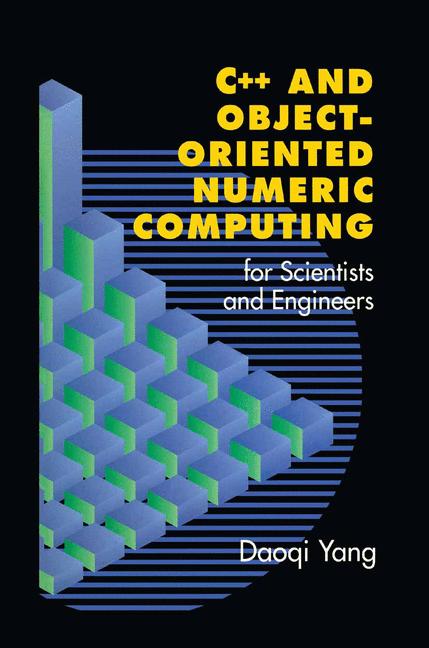
C++ and Object-Oriented Numeric Computing for Scientists and Engineers
☆☆☆☆☆
(0 reviews)
Lowest price (incl. delivery)
7 464,00 JPY
Typical price61,50 PLN
Lowest (90 days)61,50 PLN
Offers3
Last updatedvor 3 Tagen
| Verkäufer | Product price | Delivery | Gesamt | Verfügbarkeit | Updated | |
|---|---|---|---|---|---|---|
| SP SpringerNatureLink Shop INT | 7 435,00 JPY | 29,00 JPY | 7 464,00 JPY | Verfügbar | vor 3 Tagen | View offer |
| SP SpringerNatureLink Shop INT | 61,50 EUR | 19,00 EUR | 80,50 EUR | Verfügbar | vor 3 Tagen | View offer |
| SP Springer Nature Author | 61,50 EUR | free | 61,50 EUR | Verfügbar | vor 1 Woche | View offer |
Preise und Verfügbarkeit können sich ändern. Zuletzt aktualisiert: 15.08.2026 07:53.
EAN
9781461301899
Springer Nature
0,0
☆☆☆☆☆
0 reviews
5★
0%
4★
0%
3★
0%
2★
0%
1★
0%
Product reviews
No reviews yet — be the first!
This book is intended to be an easy, concise, but rather complete, introduc the ISO/ANSI C++ programming language with special empha tion to sis on object-oriented numeric computation for students and professionals in science and engineering. The description of the language is platform independent. Thus it applies to different operating systems such as UNIX, Linux, MacOS, Windows, and DOS, as long as a standard C++ compiler is equipped. The prerequisite of this book is elementary knowledge of cal culus and linear algebra. However, this prerequisite is hardly necessary if this book is going to be used as a textbook for teaching C++ and all the sections on numeric methods are skipped. Programming experience in an other language such as FORTRAN, C, Ada, Pascal, Maple, or Matlab will certainly help, but is not presumed. All C++ features are introduced in an easy way through concepts such as functions, complex numbers, vectors, matrices, and integrals, which are familiar to every student and professional in science and engineering. In the final chapter, advanced features that are not found in FORTRAN, C, Ada, or Matlab, are illustrated in the context of iterative algorithms for linear systems such as the preconditioned conjugate gradient (CG) method and generalized minimum residual (GMRES) method. Knowledge of CG, GMRES, and preconditioning techniques is not presumed and they are ex plained in detail at the algorithmic level.
Similar products
 50 Years of Philosophy and Medicine
from $107.30
50 Years of Philosophy and Medicine
from $107.30
 Understanding Cybersecurity Law and Digital Privacy
from $122.63
Understanding Cybersecurity Law and Digital Privacy
from $122.63
 Decisions in International Trade and Logistics
from $122.63
Decisions in International Trade and Logistics
from $122.63
 Advances in Economic Measurement
from $122.63
Advances in Economic Measurement
from $122.63
 Nanomaterials
from $137.96
Nanomaterials
from $137.96
 Sustainable Scaffolds-based Strategies in Tissue Engineering and Regenerative Medicine
from $162.87
Sustainable Scaffolds-based Strategies in Tissue Engineering and Regenerative Medicine
from $162.87
 Narratives in Educational Research
from $162.87
Narratives in Educational Research
from $162.87
 Environmental Biology of the Young Chinese Sturgeon
from $210.78
Environmental Biology of the Young Chinese Sturgeon
from $210.78