
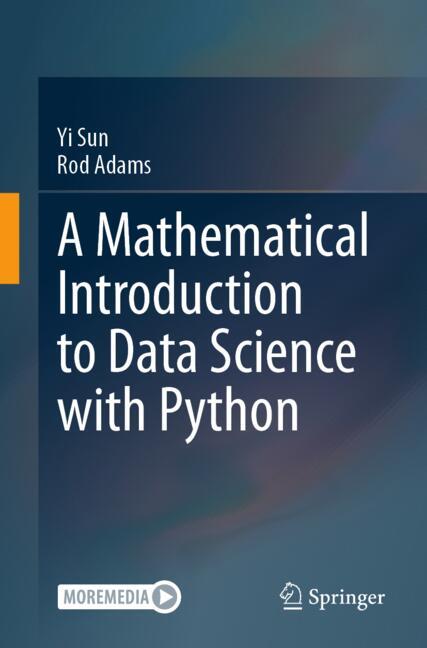
A Mathematical Introduction to Data Science with Python
☆☆☆☆☆
(0 reviews)
Lowest price (incl. delivery)
78,99 USD
Typical price53,79 PLN
Lowest (90 days)35,99 PLN
Offers6
Last updatedvor 1 Woche
Price history (90 days)
Full history
2026-08-08
2026-08-15
| Aktualisiert am | Preis |
|---|---|
| 2026-08-08 | 44,99 |
| 2026-08-14 | 35,99 |
| 2026-08-15 | 59,99 |
| Verkäufer | Product price | Delivery | Gesamt | Verfügbarkeit | Updated | |
|---|---|---|---|---|---|---|
| SP SpringerNatureLink Shop INT | 59,99 USD | 19,00 USD | 78,99 USD | Verfügbar | vor 4 Tagen | View offer |
| SP SpringerNatureLink Shop INT | 59,99 USD | free | 59,99 USD | Verfügbar | vor 4 Tagen | View offer |
| SP SpringerNatureLink Shop INT | 64,99 USD | free | 64,99 USD | Verfügbar | vor 4 Tagen | View offer |
| SP SpringerNatureLink Shop INT | 64,99 USD | 19,00 USD | 83,99 USD | Verfügbar | vor 4 Tagen | View offer |
| SP Springer Nature Author | 64,99 USD | 15,00 USD | 79,99 USD | Verfügbar | vor 1 Woche | View offer |
| SP SpringerNatureLink Shop INT | 64,19 EUR | 19,00 EUR | 83,19 EUR | Verfügbar | vor 4 Tagen | View offer |
Preise und Verfügbarkeit können sich ändern. Zuletzt aktualisiert: 08.08.2026 11:42.
0,0
☆☆☆☆☆
0 reviews
5★
0%
4★
0%
3★
0%
2★
0%
1★
0%
Product reviews
No reviews yet — be the first!
This textbook serves as a companion to "A Mathematical Introduction to Data Science". It uses Python programming to provide a comprehensive foundation in the mathematics needed for data science. It is designed for anyone with a basic mathematical background, including students and self-learners interested in understanding the principles behind the computational algorithms used in data science. The focus of this book is to demonstrate how programming can aid in this understanding and be used in solving mathematical problems. It is written using Python as its programming language, but readers do not need prior knowledge of Python to benefit from it. Some examples from "A Mathematical Introduction to Data Science" are used to illustrate key concepts such as sets, functions, linear algebra, calculus, and probability and statistics, through Python programming, though it is not necessary to have seen the examples before. Further, this textbook shows how those mathematical concepts can be applied in widely used computational algorithms, such as Principal Component Analysis, Singular Value Decomposition, Linear Regression in two and more dimensions, Simple Neural Networks, Maximum Likelihood Estimation, Logistic Regression and Ridge Regression. This textbook is designed with the assumption that readers have no prior knowledge of Python but possess a basic understanding of programming concepts, such as control flow. Ideally, readers should have both this book and its companion, "A Mathematical Introduction to Data Science". However, those with a strong mathematical background and an interest in programming implementations can benefit from reading this textbook alone.
Similar products
 50 Years of Philosophy and Medicine
from $107.30
50 Years of Philosophy and Medicine
from $107.30
 Understanding Cybersecurity Law and Digital Privacy
from $122.63
Understanding Cybersecurity Law and Digital Privacy
from $122.63
 Decisions in International Trade and Logistics
from $122.63
Decisions in International Trade and Logistics
from $122.63
 Advances in Economic Measurement
from $122.63
Advances in Economic Measurement
from $122.63
 Nanomaterials
from $137.96
Nanomaterials
from $137.96
 Sustainable Scaffolds-based Strategies in Tissue Engineering and Regenerative Medicine
from $162.87
Sustainable Scaffolds-based Strategies in Tissue Engineering and Regenerative Medicine
from $162.87
 Narratives in Educational Research
from $162.87
Narratives in Educational Research
from $162.87
 Environmental Biology of the Young Chinese Sturgeon
from $210.78
Environmental Biology of the Young Chinese Sturgeon
from $210.78