
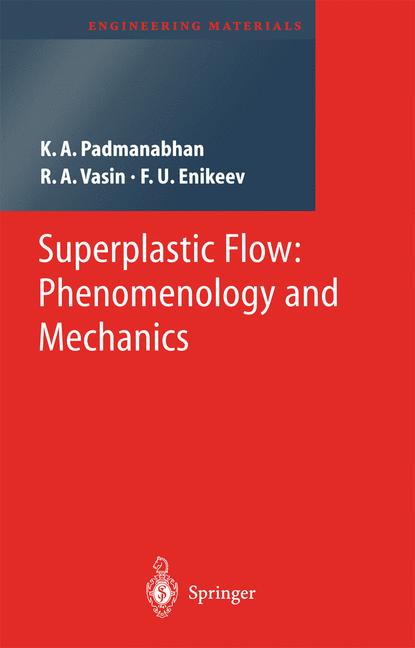
Superplastic Flow
☆☆☆☆☆
(0 reviews)
Lowest price (incl. delivery)
21 449,00 JPY
Typical price3 712,91 PLN
Lowest (90 days)155,99 PLN
Offers1
Last updatedpřed 2 dny
| Prodejce | Product price | Delivery | Celkem | Dostupnost | Updated | |
|---|---|---|---|---|---|---|
| SP Springer Nature Author | 21 449,00 JPY | free | 21 449,00 JPY | Dostupné | před 2 dny | View offer |
Ceny a dostupnost se mohou změnit. Naposledy aktualizováno: 08.08.2026 23:34.
0,0
☆☆☆☆☆
0 reviews
5★
0%
4★
0%
3★
0%
2★
0%
1★
0%
Product reviews
No reviews yet — be the first!
Superplasticity is the ability of polycrystalline materials under certain conditions to exhibit extreme tensile elongation in a nearly homogeneous/isotropic manner. Historically, this phenomenon was discovered and systematically studied by metallurgists and physicists. They, along with practising engineers, used materials in the superplastic state for materials forming applications. Metallurgists concluded that they had the necessary information on superplasticity and so theoretical studies focussed mostly on understanding the physical and metallurgi cal properties of superplastic materials. Practical applications, in contrast, were led by empirical approaches, rules of thumb and creative design. It has become clear that mathematical models of superplastic deformation as well as analyses for metal working processes that exploit the superplastic state are not adequate. A systematic approach based on the methods of mechanics of solids is likely to prove useful in improving the situation. The present book aims at the following. 1. Outline briefly the techniques of mechanics of solids, particularly as it applies to strain rate sensitive materials. 2. Assess the present level of investigations on the mechanical behaviour of superplastics. 3. Formulate the main issues and challenges in mechanics ofsuperplasticity. 4. Analyse the mathematical models/constitutive equations for superplastic flow from the viewpoint of mechanics. 5. Review the models of superplastic metal working processes. 6. Indicate with examples new results that may be obtained using the methods of mechanics of solids.
Similar products
 Gamma Knife Neurosurgery in the Management of Intracranial Disorders
from $210.78
Gamma Knife Neurosurgery in the Management of Intracranial Disorders
from $210.78
 SDGs in Construction Economics and Organization
from $210.78
SDGs in Construction Economics and Organization
from $210.78
 Emerging Therapies in Neurorehabilitation III
from $210.78
Emerging Therapies in Neurorehabilitation III
from $210.78
 Ground Improvement Techniques
from $220.36
Ground Improvement Techniques
from $220.36
 Anomaly Detection in Video Surveillance
from $220.36
Anomaly Detection in Video Surveillance
from $220.36
 Mechanism and Machine Science
from $287.42
Mechanism and Machine Science
from $287.42
 Protein-Protein Interactions as New Drug Targets
from $287.42
Protein-Protein Interactions as New Drug Targets
from $287.42
 Proceedings of the 7th International Conference of Transportation Research Group of India (CTRG 2023
from $287.42
Proceedings of the 7th International Conference of Transportation Research Group of India (CTRG 2023
from $287.42