
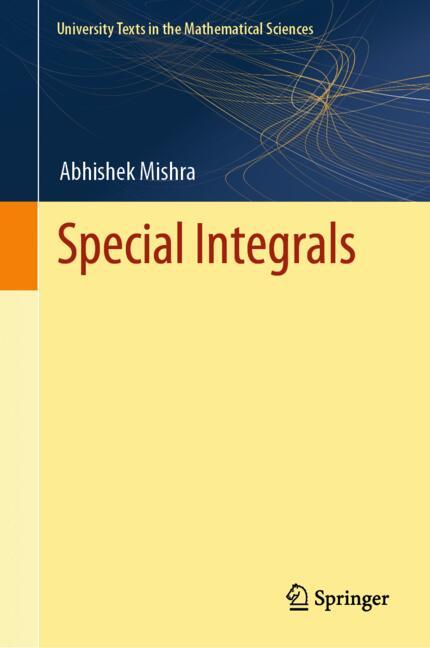
Special Integrals
☆☆☆☆☆
(0 reviews)
Lowest price (incl. delivery)
69,99 USD
Typical price68,77 PLN
Lowest (90 days)58,84 PLN
Offers6
Last updatedpřed 1 týdnem
Price history (90 days)
Full history
2026-08-08
2026-08-15
| Aktualizováno | Cena |
|---|---|
| 2026-08-08 | 58,84 |
| 2026-08-15 | 58,84 |
| Prodejce | Product price | Delivery | Celkem | Dostupnost | Updated | |
|---|---|---|---|---|---|---|
| SP SpringerNatureLink Shop INT | 69,99 USD | free | 69,99 USD | Dostupné | před 4 dny | View offer |
| SP SpringerNatureLink Shop INT | 69,99 USD | free | 69,99 USD | Dostupné | před 4 dny | View offer |
| SP SpringerNatureLink Shop INT | 79,99 USD | free | 79,99 USD | Dostupné | před 4 dny | View offer |
| SP SpringerNatureLink Shop INT | 79,99 USD | 25,00 USD | 104,99 USD | Dostupné | před 4 dny | View offer |
| SP Springer Nature Author | 79,99 USD | 15,00 USD | 94,99 USD | Dostupné | před 1 týdnem | View offer |
| SP SpringerNatureLink Shop INT | 76,99 EUR | 19,00 EUR | 95,99 EUR | Dostupné | před 4 dny | View offer |
Ceny a dostupnost se mohou změnit. Naposledy aktualizováno: 08.08.2026 12:17.
0,0
☆☆☆☆☆
0 reviews
5★
0%
4★
0%
3★
0%
2★
0%
1★
0%
Product reviews
No reviews yet — be the first!
Targeted to upper-undergraduate and graduate students of mathematics, this book discusses special integrals and their applications in finding certain series sums. It starts with the differentiation and the integration methods for summing a series that is applied to find the sum of various binomial and trigonometrical series. It also discusses methods to find the sum of series involving the variables having exponents in integral or fractional powers of 2. Complex variables are freely used to derive several theorems, which result in several special integrals and series sums. Bessel coefficients, Bessel functions, and their various generalizations are also discussed in the book. As a particular case of generalized Bessel functions, pseudo-exponential functions are defined, and their properties are studied in the book. Broadly divided into two parts—Part 1 and Part 2—the book has six chapters in Part 1, whereas Part 2 has six chapters on solutions to the problems in Part 1. To understand the topics in the book, the minimum prerequisites are the knowledge of calculus, complex analysis, and Fourier series.
Similar products
 50 Years of Philosophy and Medicine
from $107.30
50 Years of Philosophy and Medicine
from $107.30
 Understanding Cybersecurity Law and Digital Privacy
from $122.63
Understanding Cybersecurity Law and Digital Privacy
from $122.63
 Decisions in International Trade and Logistics
from $122.63
Decisions in International Trade and Logistics
from $122.63
 Advances in Economic Measurement
from $122.63
Advances in Economic Measurement
from $122.63
 Nanomaterials
from $137.96
Nanomaterials
from $137.96
 Sustainable Scaffolds-based Strategies in Tissue Engineering and Regenerative Medicine
from $162.87
Sustainable Scaffolds-based Strategies in Tissue Engineering and Regenerative Medicine
from $162.87
 Narratives in Educational Research
from $162.87
Narratives in Educational Research
from $162.87
 Environmental Biology of the Young Chinese Sturgeon
from $210.78
Environmental Biology of the Young Chinese Sturgeon
from $210.78