
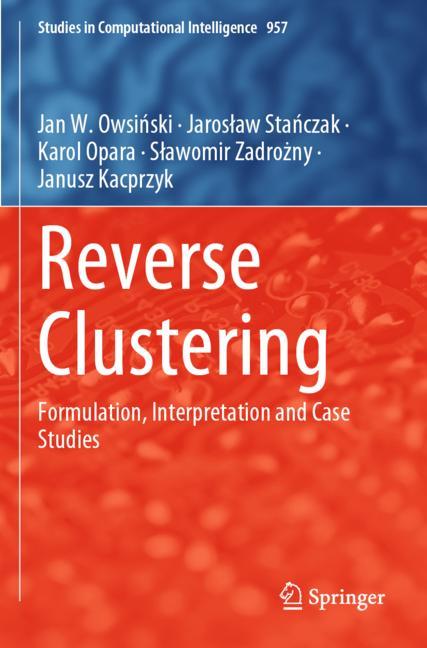
Reverse Clustering
☆☆☆☆☆
(0 reviews)
Lowest price (incl. delivery)
146,69 EUR
Typical price2 216,73 PLN
Lowest (90 days)117,69 PLN
Offers7
Last updatedpřed 4 dny
Price history (90 days)
Full history
2026-08-08
2026-08-15
| Aktualizováno | Cena |
|---|---|
| 2026-08-08 | 117,69 |
| 2026-08-15 | 119,99 |
| Prodejce | Product price | Delivery | Celkem | Dostupnost | Updated | |
|---|---|---|---|---|---|---|
| SP SpringerNatureLink Shop INT | 117,69 EUR | 29,00 EUR | 146,69 EUR | Dostupné | před 4 dny | View offer |
| SP SpringerNatureLink Shop INT | 20 019,00 JPY | 19,00 JPY | 20 038,00 JPY | Dostupné | před 3 dny | View offer |
| SP Springer Nature Author | 20 019,00 JPY | free | 20 019,00 JPY | Dostupné | před 1 týdnem | View offer |
| SP SpringerNatureLink Shop INT | 139,99 USD | 15,00 USD | 154,99 USD | Dostupné | před 4 dny | View offer |
| SP SpringerNatureLink Shop INT | 159,99 USD | free | 159,99 USD | Dostupné | před 4 dny | View offer |
| SP SpringerNatureLink Shop INT | 159,99 USD | 19,00 USD | 178,99 USD | Dostupné | před 4 dny | View offer |
| SP SpringerNatureLink Shop INT | 165,50 EUR | 25,00 EUR | 190,50 EUR | Dostupné | před 4 dny | View offer |
Ceny a dostupnost se mohou změnit. Naposledy aktualizováno: 15.08.2026 04:16.
0,0
☆☆☆☆☆
0 reviews
5★
0%
4★
0%
3★
0%
2★
0%
1★
0%
Product reviews
No reviews yet — be the first!
This book presents a new perspective on and a new approach to a wide spectrum of situations, related to data analysis, actually, a kind of a new paradigm. Namely, for a given data set and its partition, whose origins may be of any kind, the authors try to reconstruct this partition on the basis of the data set given, using very broadly conceived clustering procedure. The main advantages of this new paradigm concern the substantive aspects of the particular cases considered, mainly in view of the variety of interpretations, which can be assumed in the framework of the paradigm. Due to the novel problem formulation and the flexibility in the interpretations of this problem and its components, the domains, which are encompassed (or at least affected) by the potential use of the paradigm, include cluster analysis, classification, outlier detection, feature selection, and even factor analysis as well as geometry of the data set. The book is useful for all those who look for new, nonconventional approaches to their data analysis problems.
Similar products
 50 Years of Philosophy and Medicine
from $107.30
50 Years of Philosophy and Medicine
from $107.30
 Understanding Cybersecurity Law and Digital Privacy
from $122.63
Understanding Cybersecurity Law and Digital Privacy
from $122.63
 Decisions in International Trade and Logistics
from $122.63
Decisions in International Trade and Logistics
from $122.63
 Advances in Economic Measurement
from $122.63
Advances in Economic Measurement
from $122.63
 Nanomaterials
from $137.96
Nanomaterials
from $137.96
 Sustainable Scaffolds-based Strategies in Tissue Engineering and Regenerative Medicine
from $162.87
Sustainable Scaffolds-based Strategies in Tissue Engineering and Regenerative Medicine
from $162.87
 Narratives in Educational Research
from $162.87
Narratives in Educational Research
from $162.87
 Environmental Biology of the Young Chinese Sturgeon
from $210.78
Environmental Biology of the Young Chinese Sturgeon
from $210.78