
New Digital Signal Processing Methods
☆☆☆☆☆
(0 reviews)
Lowest price (incl. delivery)
18 328,00 JPY
Typical price4 689,00 PLN
Lowest (90 days)151,00 PLN
Offers3
Last updatedpřed 1 týdnem
Price history (90 days)
Full history
2026-08-08
2026-08-15
| Aktualizováno | Cena |
|---|---|
| 2026-08-08 | 151,00 |
| 2026-08-15 | 151,00 |
| Prodejce | Product price | Delivery | Celkem | Dostupnost | Updated | |
|---|---|---|---|---|---|---|
| SP SpringerNatureLink Shop INT | 18 303,00 JPY | 25,00 JPY | 18 328,00 JPY | Dostupné | před 5 dny | View offer |
| SP Springer Nature Author | 18 303,00 JPY | 25,00 JPY | 18 328,00 JPY | Dostupné | před 1 týdnem | View offer |
| SP SpringerNatureLink Shop INT | 151,00 EUR | 15,00 EUR | 166,00 EUR | Dostupné | před 5 dny | View offer |
Ceny a dostupnost se mohou změnit. Naposledy aktualizováno: 08.08.2026 23:29.
EAN
9783030453596
Springer Nature
0,0
☆☆☆☆☆
0 reviews
5★
0%
4★
0%
3★
0%
2★
0%
1★
0%
Product reviews
No reviews yet — be the first!
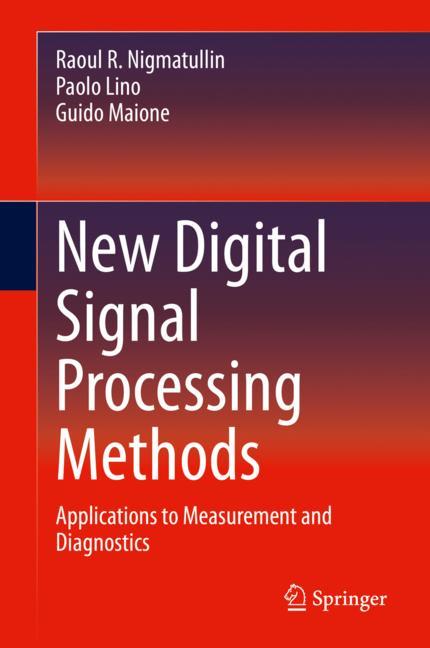
This book is intended as a manual on modern advanced statistical methods for signal processing. The objectives of signal processing are the analysis, synthesis, and modification of signals measured from different natural phenomena, including engineering applications as well. Often the measured signals are affected by noise, distortion and incompleteness, and this makes it difficult to extract significant signal information. The main topic of the book is the extraction of significant information from measured data, with the aim of reducing the data size while keeping the basic information/knowledge about the peculiarities and properties of the analyzed system; to this aim, advanced and recently developed methods in signal analysis and treatment are introduced and described in depth. More in details, the book covers the following new advanced topics (and the corresponding algorithms), including detailed descriptions and discussions: the Eigen-Coordinates (ECs) method, The statistics of the fractional moments, The quantitative "universal" label (QUL) and the universal distribution function for the relative fluctuations (UDFRF), the generalized Prony spectrum, the Non-orthogonal Amplitude Frequency Analysis of the Smoothed Signals (NAFASS), the discrete geometrical invariants (DGI) serving as the common platform for quantitative comparison of different random functions. Although advanced topics are discussed in signal analysis, each subject is introduced gradually, with the use of only the necessary mathematics, and avoiding unnecessary abstractions. Each chapter presents testing and verification examples on real data for each proposed method. In comparison with other books, here it is adopted a more practical approach with numerous real case studies.
Similar products
 50 Years of Philosophy and Medicine
from $107.30
50 Years of Philosophy and Medicine
from $107.30
 Understanding Cybersecurity Law and Digital Privacy
from $122.63
Understanding Cybersecurity Law and Digital Privacy
from $122.63
 Decisions in International Trade and Logistics
from $122.63
Decisions in International Trade and Logistics
from $122.63
 Advances in Economic Measurement
from $122.63
Advances in Economic Measurement
from $122.63
 Nanomaterials
from $137.96
Nanomaterials
from $137.96
 Sustainable Scaffolds-based Strategies in Tissue Engineering and Regenerative Medicine
from $162.87
Sustainable Scaffolds-based Strategies in Tissue Engineering and Regenerative Medicine
from $162.87
 Narratives in Educational Research
from $162.87
Narratives in Educational Research
from $162.87
 Environmental Biology of the Young Chinese Sturgeon
from $210.78
Environmental Biology of the Young Chinese Sturgeon
from $210.78