
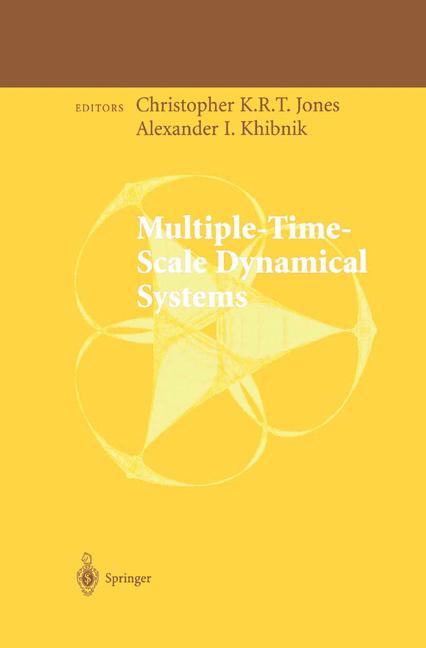
Multiple-Time-Scale Dynamical Systems
☆☆☆☆☆
(0 reviews)
Lowest price (incl. delivery)
21 474,00 JPY
Typical price2 982,55 PLN
Lowest (90 days)129,99 PLN
Offers6
Last updatedpřed 6 dny
Price history (90 days)
Full history
2026-08-08
2026-08-15
| Aktualizováno | Cena |
|---|---|
| 2026-08-08 | 129,99 |
| 2026-08-15 | 155,99 |
| Prodejce | Product price | Delivery | Celkem | Dostupnost | Updated | |
|---|---|---|---|---|---|---|
| SP SpringerNatureLink Shop INT | 21 449,00 JPY | 25,00 JPY | 21 474,00 JPY | Dostupné | před 7 hodinami | View offer |
| SP Springer Nature Author | 21 449,00 JPY | 29,00 JPY | 21 478,00 JPY | Dostupné | před 6 dny | View offer |
| SP SpringerNatureLink Shop INT | 149,99 USD | 19,00 USD | 168,99 USD | Dostupné | před 9 hodinami | View offer |
| SP SpringerNatureLink Shop INT | 169,99 USD | 29,00 USD | 198,99 USD | Dostupné | před 9 hodinami | View offer |
| SP SpringerNatureLink Shop INT | 169,99 USD | 15,00 USD | 184,99 USD | Dostupné | před 9 hodinami | View offer |
| SP SpringerNatureLink Shop INT | 177,00 EUR | 19,00 EUR | 196,00 EUR | Dostupné | před 8 hodinami | View offer |
Ceny a dostupnost se mohou změnit. Naposledy aktualizováno: 08.08.2026 23:33.
0,0
☆☆☆☆☆
0 reviews
5★
0%
4★
0%
3★
0%
2★
0%
1★
0%
Product reviews
No reviews yet — be the first!
Systems with sub-processes evolving on many different time scales are ubiquitous in applications: chemical reactions, electro-optical and neuro-biological systems, to name just a few. This volume contains papers that expose the state of the art in mathematical techniques for analyzing such systems. Recently developed geometric ideas are highlighted in this work that includes a theory of relaxation-oscillation phenomena in higher dimensional phase spaces. Subtle exponentially small effects result from singular perturbations implicit in certain multiple time scale systems. Their role in the slow motion of fronts, bifurcations, and jumping between invariant tori are all explored here. Neurobiology has played a particularly stimulating role in the development of these techniques and one paper is directed specifically at applying geometric singular perturbation theory to reveal the synchrony in networks of neural oscillators.
Similar products
 50 Years of Philosophy and Medicine
from $107.30
50 Years of Philosophy and Medicine
from $107.30
 Understanding Cybersecurity Law and Digital Privacy
from $122.63
Understanding Cybersecurity Law and Digital Privacy
from $122.63
 Decisions in International Trade and Logistics
from $122.63
Decisions in International Trade and Logistics
from $122.63
 Advances in Economic Measurement
from $122.63
Advances in Economic Measurement
from $122.63
 Nanomaterials
from $137.96
Nanomaterials
from $137.96
 Sustainable Scaffolds-based Strategies in Tissue Engineering and Regenerative Medicine
from $162.87
Sustainable Scaffolds-based Strategies in Tissue Engineering and Regenerative Medicine
from $162.87
 Narratives in Educational Research
from $162.87
Narratives in Educational Research
from $162.87
 Environmental Biology of the Young Chinese Sturgeon
from $210.78
Environmental Biology of the Young Chinese Sturgeon
from $210.78