
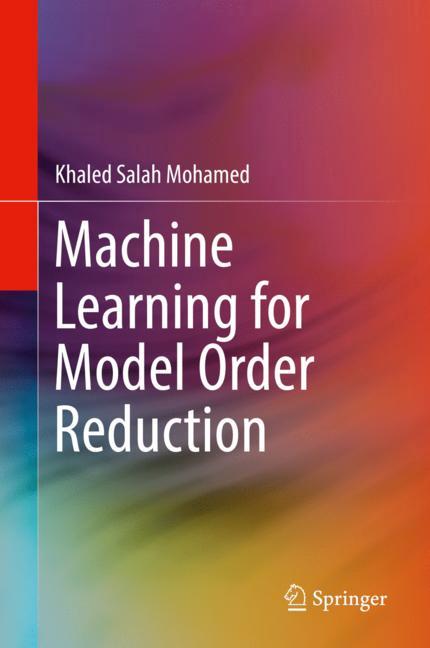
Machine Learning for Model Order Reduction
☆☆☆☆☆
(0 reviews)
Lowest price (incl. delivery)
115,29 USD
Typical price1 077,13 PLN
Lowest (90 days)87,50 PLN
Offers7
Last updatedpřed 1 týdnem
Price history (90 days)
Full history
2026-08-08
2026-08-15
| Aktualizováno | Cena |
|---|---|
| 2026-08-08 | 87,50 |
| 2026-08-15 | 87,50 |
| Prodejce | Product price | Delivery | Celkem | Dostupnost | Updated | |
|---|---|---|---|---|---|---|
| SP SpringerNatureLink Shop INT | 96,29 USD | 19,00 USD | 115,29 USD | Dostupné | před 5 dny | View offer |
| SP SpringerNatureLink Shop INT | 17 159,00 JPY | 29,00 JPY | 17 188,00 JPY | Dostupné | před 5 dny | View offer |
| SP Springer Nature Author | 17 159,00 JPY | free | 17 159,00 JPY | Dostupné | před 1 týdnem | View offer |
| SP SpringerNatureLink Shop INT | 119,99 USD | 25,00 USD | 144,99 USD | Dostupné | před 5 dny | View offer |
| SP SpringerNatureLink Shop INT | 129,99 USD | free | 129,99 USD | Dostupné | před 5 dny | View offer |
| SP SpringerNatureLink Shop INT | 129,99 USD | free | 129,99 USD | Dostupné | před 5 dny | View offer |
| SP SpringerNatureLink Shop INT | 142,00 EUR | 29,00 EUR | 171,00 EUR | Dostupné | před 5 dny | View offer |
Ceny a dostupnost se mohou změnit. Naposledy aktualizováno: 08.08.2026 22:18.
0,0
☆☆☆☆☆
0 reviews
5★
0%
4★
0%
3★
0%
2★
0%
1★
0%
Product reviews
No reviews yet — be the first!
This Book discusses machine learning for model order reduction, which can be used in modern VLSI design to predict the behavior of an electronic circuit, via mathematical models that predict behavior. The author describes techniques to reduce significantly the time required for simulations involving large-scale ordinary differential equations, which sometimes take several days or even weeks. This method is called model order reduction (MOR), which reduces the complexity of the original large system and generates a reduced-order model (ROM) to represent the original one. Readers will gain in-depth knowledge of machine learning and model order reduction concepts, the tradeoffs involved with using various algorithms, and how to apply the techniques presented to circuit simulations and numerical analysis. Introduces machine learning algorithms at the architecture level and the algorithm levels of abstraction; Describes new, hybrid solutions for model order reduction; Presents machine learning algorithms in depth, but simply; Uses real, industrial applications to verify algorithms.
Similar products
 50 Years of Philosophy and Medicine
from $107.30
50 Years of Philosophy and Medicine
from $107.30
 Understanding Cybersecurity Law and Digital Privacy
from $122.63
Understanding Cybersecurity Law and Digital Privacy
from $122.63
 Decisions in International Trade and Logistics
from $122.63
Decisions in International Trade and Logistics
from $122.63
 Advances in Economic Measurement
from $122.63
Advances in Economic Measurement
from $122.63
 Nanomaterials
from $137.96
Nanomaterials
from $137.96
 Sustainable Scaffolds-based Strategies in Tissue Engineering and Regenerative Medicine
from $162.87
Sustainable Scaffolds-based Strategies in Tissue Engineering and Regenerative Medicine
from $162.87
 Narratives in Educational Research
from $162.87
Narratives in Educational Research
from $162.87
 Environmental Biology of the Young Chinese Sturgeon
from $210.78
Environmental Biology of the Young Chinese Sturgeon
from $210.78