
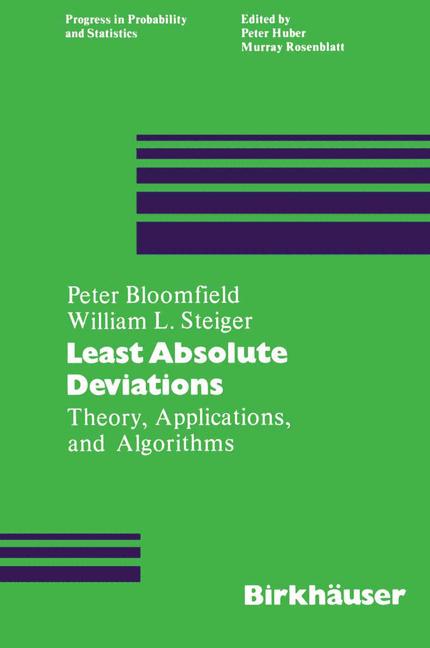
Least Absolute Deviations
☆☆☆☆☆
(0 reviews)
Lowest price (incl. delivery)
7 174,00 JPY
Typical price362,20 PLN
Lowest (90 days)49,99 PLN
Offers2
Last updatedpřed 12 hodinami
| Prodejce | Product price | Delivery | Celkem | Dostupnost | Updated | |
|---|---|---|---|---|---|---|
| SP Springer Nature Author | 7 149,00 JPY | 25,00 JPY | 7 174,00 JPY | Dostupné | před 12 hodinami | View offer |
| SP SpringerNatureLink Shop INT | 59,00 EUR | free | 59,00 EUR | Dostupné | před 1 dnem | View offer |
Ceny a dostupnost se mohou změnit. Naposledy aktualizováno: 08.08.2026 23:12.
0,0
☆☆☆☆☆
0 reviews
5★
0%
4★
0%
3★
0%
2★
0%
1★
0%
Product reviews
No reviews yet — be the first!
Least squares is probably the best known method for fitting linear models and by far the most widely used. Surprisingly, the discrete L 1 analogue, least absolute deviations (LAD) seems to have been considered first. Possibly the LAD criterion was forced into the background because of the com putational difficulties associated with it. Recently there has been a resurgence of interest in LAD. It was spurred on by work that has resulted in efficient al gorithms for obtaining LAD fits. Another stimulus came from robust statistics. LAD estimates resist undue effects from a feyv, large errors. Therefore. in addition to being robust, they also make good starting points for other iterative, robust procedures. The LAD criterion has great utility. LAD fits are optimal for linear regressions where the errors are double exponential. However they also have excellent properties well outside this narrow context. In addition they are useful in other linear situations such as time series and multivariate data analysis. Finally, LAD fitting embodies a set of ideas that is important in linear optimization theory and numerical analysis. viii PREFACE In this monograph we will present a unified treatment of the role of LAD techniques in several domains. Some of the material has appeared in recent journal papers and some of it is new. This presentation is organized in the following way. There are three parts, one for Theory, one for Applicatior.s and one for Algorithms.
Similar products
 Patient Safety Coaching
from $91.97
Patient Safety Coaching
from $91.97
 Ethnography and Diversity
from $69.30
Ethnography and Diversity
from $69.30
 Smart Villages
from $91.97
Smart Villages
from $91.97
 Nuclear Non-Proliferation in International Law - Volume VI
from $91.97
Nuclear Non-Proliferation in International Law - Volume VI
from $91.97
 The Price of Freedom
from $91.97
The Price of Freedom
from $91.97
 Eco-Social Policy in the OECD and the World Bank
from $91.97
Eco-Social Policy in the OECD and the World Bank
from $91.97
 Special Topics in Policing
from $122.58
Special Topics in Policing
from $122.58
 Music from the Heart
from $91.97
Music from the Heart
from $91.97